Showing posts with label Classics. Show all posts

Wednesday, January 27, 2010

42. “Pride and Prejudice” by Jane Austen


Year of first publication: 1813
Genre: novel, novel of manners, romantic comedy, realist novel
Country: United Kingdom

In italiano: “Orgoglio e Pregiudizio” di Jane Austen, edito (per esempio) da Garzanti (2009), € 7,50

Plot: Mrs Bennet has five daughters and they are all in need of a husband. Mr Bingley, a wealthy young gentleman, rents an estate near the Bennets, thus presenting the perfect occasion to find a good match for the girls. While Mr Bingley is immediately attracted to Jane, the most beautiful of the Bennets, his good friend Mr Darcy is haughty and cold, particularly towards Elizabeth, the most intelligent and outspoken of the girls. Elizabeth makes the acquaintance of Mr Wickham, an officer in the militia stationed nearby, who has been mistreated by Darcy in the past. She then starts to hate Darcy for what she has been told about him. In the meantime, Jane and Bingley grow closer, despite the opposition of his sisters who consider her socially inferior. Things become more complicated when Mr Bingley inexplicably leaves the estate breaking the hopes of a marriage with Jane and Darcy falls in love with Elizabeth who continues to scorn him.

Some thoughts: After having studied the book at school and having seen two adaptations, but never having ventured after page 50 of the book itself, I finally decided to pluck up the courage and read this novel from the beginning to the end. I was never attracted to Jane Austen’s novels, but maybe it was just a bias against romantic comedies.
I appreciated Austen’s ability to detail the inner life of people, especially young women. The psychology of the characters is astonishing: I loved Elizabeth Bennett and I was fascinated with Mr Darcy. He’s one of those characters, like Rashkolnikov in Crime and Punishment, who despite being unpleasant and unsociable for most of the novel, has an undeniable charm. There is also comic intent in some of the characters, for instance the unbelievably ridiculous Mr Collins or the equally hilarious Mrs Bennett with all her frivolity and obsession for the marriage of her daughters. They’re not round characters, but they add a “comic relief” to an otherwise very serious novel. Some people suggested that Pride and Prejudice is also a feminist novel ante litteram, because Elizabeth Bennett has a strong spirit of independence. Honestly, I think it’s a stretch. What is unusual and remarkable for a novel of that time is Elizabeth’s attitude towards conventions. With this novel, a new kind of hero (and heroine) is born: one that has some faults (pride and prejudice, indeed) as well as many virtues.
In spite of all this, I’m still not a proper “Janeite”, simply because I’m not a big fan of novels of manners, where characters have to respect a social code that, for instance, encourages them to marry for money when they would like to follow their passions and have love marriages, instead. It all feels very distant from my life. In the society I live in, women no longer need to marry to have economic stability and the main aspiration of a man “in possession of a good fortune” is no longer marriage. Nonetheless I understand why in other cultures, where women have considerably less freedom and marriage is still an important value, writers still think of Jane Austen as an important inspiration (remember that I mentioned that Rushdie thanks Austen in the preface of Midnight’s Children?).
Also, western women in no want of a career might feel very attracted to the aspirations of Jane and Elizabeth. I’m not saying that I despised the novel, because I’m very conscious of its literary and historical value. Moreover, I enjoyed it overall. It’s just that, as the English would say, it’s not my cup of tea.

By the way, a book has come out recently: Pride and Prejudice and Zombies by Jane Austen and Seth Grahame-Smith, a sort of rewriting of the book in horror-style. Anybody wants to comment on that?


About the author: Jane Austen (1775-1817) was an English novelist, still among the most widely read in the country. She was born in rural Hampshire into a family belonging to the lower fringes of English gentry and was educated at home by his father and older brothers. She never married and lived all her uneventful life within the bounds of her immediate family. Her lifelong companion was her sister Cassandra, also unmarried. She began to experiment with writing and between 1795 and 1796 she began to write what would be published in 1811 with the title Sense and Sensibility. The novel was quite successful. In 1813 she published Pride and Prejudice, a revision of a novel previously written with the title First Impressions, and Mansfield Park appeared one year after that. All of her novels were published anonymously but they were very fashionable among opinion-makers, also giving Austen some financial independence. Her last novel, Emma, was published in 1815, only two years before her death in 1817. She has been very influential for many writers who came after her, for example E.M. Forster.


Saturday, September 12, 2009

25. “Lord of the Flies” by William Golding


Year of first publication: 1954
Genre: novel, adventure novel, allegorical novel
Country: England

In italiano: Il Signore delle Mosche di William Golding, edito da Mondadori nella Collana Oscar Classici Moderni (1980), € 8,40

Nobel Prize for Literature 1983

About the author: William Golding was born in 1911 in Cornwall, England. After graduating from Oxford, he worked as a teacher actor and director, then became a schoolteacher. He participated in the Second World War and became aware of the evils of which humanity is capable. After the war, he resumed teaching and began writing novels. His first novel, Lord of the Flies (1954), after having been rejected by more than twenty publishers, became a best seller in both Britain and the USA. Golding retired from teaching and published several other novels, notably Pincher Martin (1956), and a play, The Brass Butterfly (1958). He was awarded the Nobel Prize for Literature in 1983.

Plot: A group of English schoolboys crashes on an uninhabited tropical island during a raging war. Free from the rules of society and civilization, they descend into savagery. The boys divide in two factions: a group works together and tries to achieve common goals, while the other seeks only violence and conflict. The novel is an allegory of the conflict between the civilizing instinct and the savage nature of humanity.

Some thoughts: Quite a few classics of contemporary English literature are passing in my hands in this period. This novel didn’t grab me as it should, considering its reputation. Maybe it was the writing style: Golding uses a non-poetical, straightforward language that is good for young adults (as a matter of fact, this book is widely read in secondary schools all over England) but it didn’t work well with me. Apart from this, I appreciated the philosophical interludes and the symbolisms of the novel (the shell used by Ralph to ask for an assembly, for example, represents order and democratic power; Piggy’s glasses are a symbol for science and rationality etc.).
Whether the story of Lord of the Flies is a symbol of the evils of which humanity is capable or whether it is a representation of the history of civilization until the Second World War (humanity had just come out from the horrors of war when Golding wrote the novel), it is much more than the story of a group of boys crashing on an island and trying to survive (LOST, anyone?).
The central problem of the novel is the savage instinct that lurks within every human being: the monster feared by the boys, the Lord of the Flies, is not a physical beast, but rather this evil impulse that prompts every human being to enforce one’s will with the use of violence. The novel shows how different people feel the instincts of civilization and savagery: Piggy and Ralph almost don’t have a savage instinct, even though they are briefly tempted by the savages, whether people like Roger and Jack cannot even understand why the other group want to preserve their civilization. Simon is the only truly good character, because his moral code is not forced by society. Unlike Ralph, who keeps repeating that they are all English (read civilized) boys, Simon is naturally good to everyone and in fact he gets killed, meaning that the savage instinct is far more widespread and common among people. Simon is the first one to understand that the beast doesn’t really exist but it’s rather something that’s inside them. The beast, the Lord of the Flies, physically represented by a severed sow’s head that Jack had impaled on a stake, becomes the totem of the savages. Jack learns to use the fear of the beast to scare other people and turn them to his will, a reminder of how religion and superstition can be used to manipulate people and gain power.
I would recommend this book especially to students in secondary schools, maybe when they are studying the reasons that led to the Second World War, one of the periods in history when humanity lost sight of his civilization and descended into savagery.

Friday, September 4, 2009

24. “Nineteen Eighty-four” by George Orwell


Year of first publication: 1949
Genre: dystopian fiction, science fiction
Country : England

About the author: see this post

Plot: Hidden away in the Record Department of the sprawling Ministry of Truth, Winston Smith skilfully rewrites the past to suit the needs of the Party. Yet he inwardly rebels against the totalitarian world he lives in, which demands absolute obedience and controls him through the all-seeing telescreens and the watchful eye of Big Brother, symbolic head of the Party. In his longing for truth and liberty, Smith begins a secret love affair with a fellow-worker Julia, but soon discovers the true price of freedom is betrayal.

Some thoughts: I like “dystopian” novels like Huxley’s Brave New World or Bradbury’s Fahrenheit 451 (of this one I’ve just seen the movie, though). Of Nineteen Eighty-four I had seen the movie during high-school and I vividly remember this big eye that controls everything, the Big Brother. I don’t remember if the reality show was already on TV at the time, but I think it’s quite sad that now this words, Big Brother, only remind us of trash TV.
In both Fahrenheit 451 and Nineteen Eighty-four there is a man who discovers that there is a way out of homologation and tries to gain intellectual freedom. He fights against the totalitarian regime that controls every aspect of his life and brainwashed the whole humanity.
I loved the neologisms, in particular “doublethink”, the twisted way of thinking that teaches you how to accept the opposite of what would make sense. “War is peace, freedom is slavery and ignorance is strength” is the motto of the Party and it is the finest example of “doublethink”. I know of some real politicians that use “doublethink” with nonchalance (“war on terror”, does it ring the bell?). Nineteen Eighty-Four is a frightening novel, also because many people think that the time of the events in the novel is not far away as it may seem, but it shares much with England in the 1940s, when the novel was written. Actually, while I was reading the novel I found many similarities with the modern world and in particular with the political situation in Italy: the censorship in the medias for example or the unbelievable contradictions and lies of the government (“In the end the Party would announce that two and two made five, and you would have to believe it”).
It is a novel that warns you against both communism and fascism (in other words, against every form of totalitarism). The end is very sad, I could not believe in the betrayal and I was literally dying for clues of a possible – but very unlikely - happy ending or of a little hope for the future of Julia and Winston. I didn’t like Julia much, though. I don’t mean as a character, but as a woman. It is true that she is a rebellious and independent woman, but she only cares about her sexual life and the pleasures that she cannot have, such as real coffee or sugar. Winston, on the other hand, is more interested in intellectual freedom and discovering what happened before this endless war (the glass paperweight is the symbol of his desire to connect with the past). The tone of the novel is dark, frustrated and pessimistic, but it is a wonderful novel nonetheless. It makes you think a lot. It’s one of those novels that will never leave me, like Crime and Punishment or Toni Morrison’s Beloved.

Monday, August 24, 2009

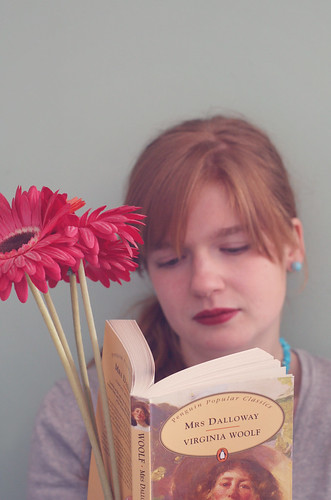
22. “Mrs. Dalloway” by Virginia Woolf

Year of first publication: 1925
Genre: modernist novel
Country: England

About the author: Virginia Woolf (1882 – 1941) was an experimental novelist, critic, short story writer and essayist of the twentieth century, best remembered for the classics, To the Lighthouse (1927) and Mrs Dalloway (1925). She was born in London in 1882, daughter of Sir Leslie Stephen, a literary critic. She was born in an upper-middle class, socially active family. She suffered her first major breakdown on the death of her father in 1904. In spite of the fact that in Victorian England women were not encouraged to attend university or participate in the literary debate, she began writing essays and reviews. Later she moved with her family to Bloomsbury where they gathered around them a set of writers and artists, including Leonard Woolf, who married Virginia in 1912. Together they set up the Hogarth Press which published Sigmund Freud, Katherine Mansfield and T.S. Eliot. Leonard also encouraged Virginia to write in her calm periods. Her first two novels are fairly conventional, but her later works are highly innovative: she used the interior monologue, or “stream of consciousness”, and poetic symbolism, with the emphasis on character as opposed to plot. Apart from the aforementioned classics, other works by Virginia Woolf include Orlando (1928), The Waves (1931) and A Room of One’s Own (1929), a feminist text. Continual mental depression led Virginia to drown herself in 1941.

Plot: In London, at the end of the First World War, Clarissa Dalloway is preparing for one of her famous parties. Unexpectedly, her first lover Peter Walsh comes back from India and brings old memories with him. Clarissa remembers her childhood dreams and the events leading to her uneventful marriage with Richard Dalloway, who gave her a comfortable life in an affluent neighbourhood of London. Around Clarissa, a set of different characters: Septimus Warren Smith, for example, who’s going mad with shell-shock and her daughter Elizabeth, who’s now almost a woman. As Septimus decides to commit suicide because he’s not able to deal with life anymore, Clarissa reflects on death and on the differences between people’s personalities.

Some thoughts: I absolutely love Virginia Woolf: I’ve already read To The Lighthouse, Orlando and most of A Room of One’s Own (I used it a lot when I was writing my graduation thesis on Janet Frame, as both authors felt the necessity to have a quiet place and enough “piece of mind” to write without too many worries). I love her “stream of consciousness” and how she portrays the inner life of different people, especially women, in their everyday actions. When I was in London I went in front of her house in Bloomsbury and took a picture, then sat in the nice park in the square just in front of it and ate my sandwich, wondering how many “deep thoughts” that place had heard from Virginia and her friends of the Bloomsbury group.
In Cunningham’s The Hours (and in the movie of the same name) there is a fictionalised version of Virginia Woolf in the period when she was writing Mrs Dalloway (and also in the period of her suicide, such a sad thing when it happens to an artist, don’t you think?). I think that the use of famous people, either dead or alive, as characters in novels (it’s becoming more and more common) reveals that the interior world of that particular person is something we still have an interest in. In this book, we don’t read about Virginia Woolf’s interior world, of course, but we learn about Mrs Dalloway’s thoughts and musings, which is quite satisfying anyway.
Given that it is quite impossible to say something on Mrs Dalloway that hasn’t already been said a hundred times, I just want to point out something that struck me. A recurring sentence in the book, which is actually a verse from Shakespeare’s Cymbeline, says: “Fear no more the heat o’ the sun / Nor the furious winter’s rages”. Both Septimus Warren Smith and Mrs Dalloway utter this sentence over and over again. Moreover, it is used in Janet Frame’s Autobiography: when the author is in the mental hospital, she keeps on scribbling this sentence (I can recall the scene in the movie very well, because she writes the sentence on the walls of her room / cell). The three of them (Septimus Warren Smith, Janet Frame and Virginia Woolf) suffered from some sort of mental illness and my interpretation, at the time when I was reading Janet Frame’s book, was completely wrong. I thought that this verse was quite hopeful, a sort of encouragement to ignore the storms in your inner world and try to live your life happily, but I found out that it is quite the opposite. The line is actually from a funeral song that celebrates death as a comfort after a difficult life. Septimus’s life has become unbearable: he has lived the horrors of the war and lost many friends, thus ordinary life in post-war London is worthless to him. Clarissa reflects on the death of her friend and feels responsible for it. Was it the same feeling experienced by Virginia Woolf moments before she drowned herself, during the Second World War, when London was being bombed? Through Shakespeare’s words, nonetheless, Clarissa can finally accept death, something that had been troubling her for the whole day. There is therefore an optimistic side to this novel that is otherwise rather sad.
I acknowledge that with this novel Virginia Woolf found her voice: she describes everyday actions like buying flowers or eating dinner, showing that no action is too ordinary for the attention of a writer. Given that Virginia Woolf was writing the novel in the period when Sigmund Freud was publishing his theories on the subconscious and there was much interest in psychology, I can understand how fascinating the mind of a human being must have been for her. The author shows that our inner lives are always very rich, but they are separated from each other’s. Despite the fact that Clarissa throws parties in order to draw people together, they remain distant and struggle to communicate with each other. It is perfectly clear that people like Clarissa or Septimus are emotional and sensitive, they like to think a lot and to reflect about life, whereas other people like Richard or Lady Bruton are more materialistic. If you pay attention, for example, flowers are a recurring theme and certainly they are a symbol of emotions and a rich inner life. In the book people treat flowers differently: Clarissa is comfortable with flowers and in the first section she is buying flowers for the party, whereas Richard handles the conventional bouquet of roses awkwardly and gives them to Lady Bruton, who lays them stiffly by the plate.
There is so much more to this novel and I’m sure it needed more attention and at least a reread (sometimes it was difficult for me to deal with the shifts of point of view, but I guess that’s the inconvenience of the stream of consciousness).

Tuesday, June 30, 2009

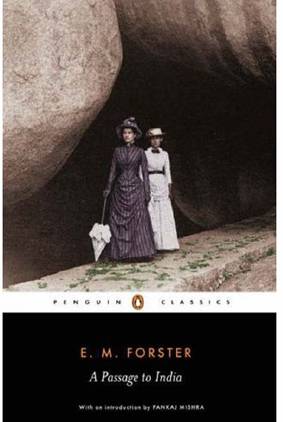
17. "A Passage to India" by E.M. Forster


Year of first publication: 1924
Genre: novel
Country: England / India

About the author: Edward Morgan Forster was born in London in 1879. His father died short afterwards and he was brought up by his mother and his great-aunt. At the university in Cambridge he was under the influence of the philosopher G.E. Moore, who inspired his faith in the importance of human relationships and in the cult of art and beauty as the only way to find harmony in this world. He lived for some time in Italy, the background of his first and third novels, Where Angels Fear to Tread (1905) and A Room with a View (1908). In both works he explored the differences between the strictness of English conventions and upper-middle-class codes of social behaviour and the more spontaneous and relaxed way of life of the Italians. Between this two books he published The Longest Journey (1907), a novel about English life. Then followed Howards End (1910), often considered his masterpiece. In 1912 he went to India for the first time and began writing an Indian novel in 1914. A Passage to India was published in 1924; it portrays post-Kipling India at a time of transition. He died in 1970 and the following year Maurice appeared, the novel he had written as early as 1914 to release and overcome the sense of guilt linked to his homosexuality, at that time still regarded as criminal offence. Forster’s books have been made into successful movies.

Plot: When Adela and her elderly companion Mrs Moore arrive in the Indian town of Chandrapore, they quickly feel trapped by its insular and prejudiced British community. Determined to explore the ‘real India’, they seek the guidance of the charming and mercurial Dr Aziz, a cultivated Indian Muslim. But a mysterious incident occurs while they are exploring the Marabar caves with Aziz, and the well-respected doctor soon finds himself at the centre of a scandal that rouses violent passions among both the British and their Indian subjects.

Some thoughts: One more classic in my bag! I’ve read somewhere that E.M. Forster is one of Zadie Smith’s favourite authors (and in fact her third novel On Beauty is an “adaptation” of Howards End) and now I understand why (so far I had only read a few passages from A Room with a View). E.M. Forster is a wonderful writer!
Forster’s main concerns are the difficulties men face in trying to understand each other, especially if there are differences of culture, race and national temperament. Forster portrays a post-Kipling India, where a transformation is taking place. A national consciousness is being formed in the country, despite the fact that the Anglo-Indians try to ignore it. Upon their arrival in Chandrapore, Adela and Mrs Moor claim that they want to see “the real India” and are bored with English people, because they behave as if they were still in England. In other words, they want a taste of the exotic. They think that they are unprejudiced and they can get along with Indian people without encounter difficulties. Mrs Moore is idealized, especially by Dr Aziz: she represents purity and harmony, a successful encounter between the east and the west. Adela, on the other hand, is a more realistic character. She is secretly attracted to Dr Aziz (it is spelled out that he is a fascinating young man), but she doesn’t want to admit it. After having entered the caves, she becomes convinced that Aziz sexually harassed her or even assaulted her. She is terrified by the thought that Dr Aziz, an Indian, might have an interest in her (which he has not, actually, but she unconsciously likes to think that he does). For an Englishwoman it is perfectly all right to have a sexual interest on an Indian (even if it would be shameful to admit it), but it is not acceptable for her that he might have a sexual desire for her. This is emphasized when, during the trial, somebody reflects on the fact that darker races find people with fair skin attractive but not the opposite (which is not true, of course).
Forster, in his Notes on the English Character wrote that the product of the public schools are Englishmen “with well-developed bodies, fairly developed minds and undeveloped hearts”. Ahah, how hilarious: he really was a witty writer after all.
In this novel, full of symbols that I don’t want to analyse here (all right, the caves are supposed to be the womb of the universe and thus the subconscious, whereas the echo represents nature’s benevolence, the harmony of creation), what strikes me the most are the hidden things. For example, there are hidden hints at homosexuality in the friendship between Dr Aziz and Mr Fielding (the scenes in the bedroom being the most obvious example) and the ending is a metaphor of the “suspicious friendship” that links England with India at a time when he British Empire is starting to decline. In other words, Kipling got it right: "Oh, East is East, and West is West, and never the twain shall meet, / Till Earth and Sky stand presently at God’s great Judgment Seat; / But there is neither East nor West, Border, nor Breed, nor Birth, / When two strong men stand face to face, tho’ they come from the ends of the earth!" (from The Ballad of East and West)
In conclusion, a truly wonderful novel and one that I would like to reread one day.

Saturday, December 6, 2008

"The Great Gatsby" by F.Scott Fitzgerald


Year of publication: 1925
Setting and Time: Long Island and New York, The Roaring Twenties
Genre: novel, modernist novel
Themes: the spirit of the 1920s, the decadence of the American dream, hypocrisy and lack of moral values, naivety, love, greed, social inequalities, underworld and speculation

About the author: Francis Scott Fitzgerald was born in 1896 in St. Paul, Minnesota. He managed to enrol to Princeton (even though he was not a brilliant student) and then got engaged to Zelda Sayre, the daughter of a Supreme Court Judge, but her overpowering desire for wealth, fun, and leisure led her to delay their wedding until he could prove a success. With the publication of This Side of Paradise in 1920, Fitzgerald became a literary sensation, earning enough money and fame to convince Zelda to marry him. Many of these events from Fitzgerald's early life appear in his most famous novel, The Great Gatsby, published in 1925.
Having become a celebrity, Fitzgerald fell into a wild, reckless life-style of parties and decadence, while desperately trying to please Zelda by writing to earn money. As the giddiness of the Roaring Twenties dissolved into the bleakness of the Great Depression, however, Zelda suffered a nervous breakdown and Fitzgerald battled alcoholism, which hampered his writing. He published Tender Is the Night in 1934, and sold his short stories to The Saturday Evening Post to support his lavish lifestyle. In 1937, he left for Hollywood to write screenplays, and in 1940, while working on his novel , The Love of the Last Tycoon, died of a heart attack at the age of forty-four.

Plot: Nick Carraway, a young man from Minnesota, moves to New York in the summer of 1922 to learn about the bond business. He rents a house in the West Egg district of Long Island, a wealthy but unfashionable area populated by the new rich, a group who have made their fortunes too recently to have established social connections and who are prone to garish displays of wealth. Nick's next-door neighbor in West Egg is a mysterious man named Jay Gatsby, who lives in a gigantic Gothic mansion and throws extravagant parties every Saturday night.

Some thoughts: This novel is a very good portrait of American society in the 1920s, an era when the ban on alcohol made millionaires out of bootleggers. Honestly, I expected more from such a classic of American literature, as I always do, but I wasn’t disappointed either. The Great Gatsby is a great depiction of the lack of morality in our society: the behaviour of Gatsby’s admirers after the news of his death is unbelievable and realistic at the same time. It is fascinating to learn how much the novel mirrors Fitzgerald’s real life: he was also in love with a girl who needed to be impressed and led a reckless life, throwing parties every week.
The opposition between the newly rich and the old aristocracy is evident in the novel. The newly rich, those who live in West Egg like Gatsby, are vulgar, gaudy and ostentatious. On the contrary, the old aristocracy, who lives in East Egg like Daisy and Tom, has taste, grace and elegance. However, they are cruel and they don’t care about people (i.e. they refuse to go to Gatsby’s funeral). Daisy and Tom move to a new house instead of dealing with Gatsby’s funeral, whereas Gatsby is loyal to his friends despite the fact that he earned his money through criminal activities. I think that this is a little bit simplistic, and that is one of the few things I didn’t like about the novel. The main characters, like Gatsby and Nick, are complex and well developed, but the minor characters sometimes are stereotyped (Daisy’s husband for example, who’s a little rough, racist and chauvinist).
The Great Gatsby is a New York Novel and I love when a city plays such an important role in a story (that’s why I like Woody Allen and Martin Scorsese). New York City is almost a character alongside Nick, Daisy and Gatsby.
What else can I say about this novel that hasn’t already been said a million times? Not much, I’m afraid. However, I quite enjoyed the novel, even though I'm not a fan of stories about "the famous and rich". A question to those who have read it: is it normal that I hated pretty much everyone in the novel?

Monday, June 30, 2008

"Heart of Darkness" by Joseph Conrad

Date of publication: 1899
Genre: fiction, novella, adventure,
Setting and time: The River Congo, end of the 19th century
Themes: colonialism, capitalism, civilization vs. barbarism, darkness vs. light, degradation of human morality

Plot: (*may contain spoilers*) Marlow, is the commander of a riverboat looking for ivory to trade in the Belgian Congo. His journey into the heart of the Congo is both a thrilling adventure and a symbolic excursion into the depths of the human psyche to confront the evil that exists there. Marlow's encounter with the mysterious and corrupted Kurtz, who has become a sort of deity for the African people, is the key moment of the story. The ‘horror’ that Kurtz claims to have found in the Congo allows Marlow to go back to England, but he’s not able to leave this terrible experience behind.

Some thoughts: I don’t want to write an essay on Heart of Darkness; too much has been written on this book (even though Calvino said that ‘a classic is a book that has never finished saying what it has to say’). It is a metaphorical, ambiguous, highly symbolic and complex story about the moral degradation of imperialism in Africa.
However, I cannot see how this novella can be considered postcolonial, because Conrad criticizes European colonialism using the rhetoric of racism. I can see why Chinua Achebe denounced the novel as racist (read his essay here). African people in Heart of Darkness are just ‘limbs and rolling eyes’, even ‘cannibals’ and ‘savages’. They don’t have names and they don’t speak (and if they do, they say ‘Mistah Kurtz – he dead’!). In other words, they are barely human! Conrad’s only intention is making them mysterious and morbidly fascinating. As Achebe wrote in his essay, it can be argued that the attitude to the African is not Conrad’s but his fictional narrator’s, Marlow. The narrator behind the narrator clearly serves the purpose of creating a distance between the moral message of the story and the author. If this was Conrad’s intention, however, he fails to hint at an alternative frame of reference by which we may judge the opinions of the characters. Sure, Conrad wrote this novel in 1899 and I live in 2008, but I find quite alarming that the text is studied so much without acknowledging that! Of course I value the symbolism and the ambiguity of the tale, but I find it terribly dated.
I also didn’t like the end of the story, when Marlow lies to Kurtz’s girlfriend about his last words. I have the impression that Conrad was a male chauvinist (is that the right word in English?). I quote directly from the text: ‘It’s queer how out of touch with truth women are’. When Marlow suggests that women have to be sheltered from the truth in order to keep their own fantasy world from ‘shattering before the firs sunset’ I was very offended!
Nonetheless, I admire Conrad because English was not his native language: he began learning it at 21 and yet he’s one of the most significant authors in the Western canon. He writes very well and his narrative is engaging, but I can’t really say that I enjoyed this book. Maybe my expectations for this classic were too great, but I can't be the only one with this feeling of uneasiness about it.

Sunday, June 22, 2008

"Il Barone Rampante" (The Baron in the Trees) by Italo Calvino

Date of publication: 1957
Genre: fiction, historical novel, fairytale / magical realism
Setting and time: Ombrosa, a fictional small town in the north west of Italy, near Genoa, in the late 18th and early 19th century
Themes: anti-conformism, role of individual and community, family, environment, romance.

About the author: Italo Calvino (1923-1985) is one of the most important contemporary Italian fiction writers of the 20th century. Calvino's first novel, Il Sentiero dei Nidi di Ragno (The Path to the Nest of Spiders, 1947) depicted resistance movement, seen through the eyes of a young boy and in Neorealistic manner. The work became famous for its fable-like twists in the narrative. Il Visconte Dimezzato (The Cloven Viscount, 1951) marked Calvino's break with the common themes connected with the experience of war: it is the story of a man cut in half by a cannonball during the Turkish-Christian war. It is the first volume of a trilogy dedicated to 'the ancestors'. The novels that follow are Il Barone Rampante (The Baron in the Trees) and Il Cavaliere Inesistente (The Nonexistent Knight, 1959). These fantastic tales, hovering between allegory and pure fantasy, brought him international acclaim and reputation. Le Città Invisibili (Invisible Cities, 1972) is a surreal fantasy in which Marco Polo invents dream-cities to amuse Kubla Khan - a city on stilts, a city made of waterpipes, a spiderweb city, a city that cannot be forgotten and so on. Of Se una Notte d’Inverno un Viaggiatore (If on a Winter's Night a Traveller, 1979) Salman Rushdie declared: ‘He is writing down what you have always known except that you've never thought of it before’. The story alternates the opening chapters of 10 different novels, opening with a man discovering that the copy of the novel he has recently purchased is defective, a Polish novel having been bound within its pages. The book includes a discourse on the experience of reading and writing. Calvino died in 1985 in Siena.

Plot: (*may contain spoilers*) Cosimo Piovasco is the son of a baron and leads an aristocratic life in a small Italian town called Rondò. One day he argues with his father and climbs a tree, finding a good shelter from the worries of life. He then decides to live the remainder of his life on the trees, finding a new perspective on the world. He leads a life full of passions, bonding with both his family and the townspeople. His life features a passionate love story, involvement in politics, encounters with famous people and some unlikely adventures.

Some thoughts: It is hard to define The Baron in the Trees in terms of genre or even intent of the author. At times, the story is similar to a fairytale, at times it is more realistic. Calvino’s fiction is sometimes labelled as postmodernism or magical realism. In my opinion, this label would apply for his later fiction, that can be compared to that of Borges and Cortazar, but the ancestors’ trilogy is different from everything else. Maybe only Buzzati would make a decent comparison.
Going back to the novel, I really liked the fact that the whole stories is not told from Cosimo’s point of view, but from his younger brother’s: it is a way of being detached from the story, but not too much. It is in large part Biagio’s re-telling of the stories Cosimo recounts on himself. You can never be sure when Cosimo is exaggerating his adventures and when his tales are real. In other words, you're dealing with an unreliable narrator à la Henry James. It’s funny how Calvino can make Cosimo interact with historical characters such as Diderot or Napoleon. Actually, the interaction between fairytales and historical novels is unusual, if not unheard of. Cosimo’s eccentric life on the trees reminds me of Shakespeare's ‘though this be madness, yet there is method in't’. In fact, Cosimo’s choice of living in the trees is dictated by the understanding that his parents’ priorities are not what he wants from life (his father chases ideals that no longer exist while his mother commemorates long-forgotten battles). It is a book about philosophy and existentialism, about alternative lifestyles and the value of community. How else could Cosimo survive on the trees without the help of his townspeople?
I was wondering if Calvino is appreciated outside Italy. If on a Winter’s Night a Traveller is one of my favourite Italian novels of all times. There’s a recent novel that has a connection to this book: Kiran Desai’s Hullabaloo in the Guava Orchard (1998), about an Indian boy trying to avoid the responsibilities of adult life and thus starting an eccentric life on the trees, like Cosimo. Did Kiran Desai read The Baron in the Trees? I think so. Did she attempt to rewrite Calvino’s book from her point of view? I don’t know. Desai’s novel is as grounded in a small Indian village as much as Calvino’s novel is grounded in the northwest of Italy. Comparative literature is indeed an interesting subject!