Showing posts with label Lists. Show all posts

Friday, October 2, 2009

Not the Booker Prize

NOT THE BOOKER PRIZE (see this post), an alternative to the Booker Prize, created by Sam Jordison, a blogger of The Guardian. Since the process of finding the six books for the shortlist was simply by leaving a comment on the blog with the title of the book, some books arrived on the shortlist by strange means. The winner will be announced in a few days, together with the Booker Prize. The shortlisted titles are:

Rana Dasgupta – Solo (review and extract)
Solo recounts the life and daydreams of a reclusive one hundred year-old man from Bulgaria.

James Palumbo – Tomas (review and extract)
Tomas tears apart the world of the rich on his crusade against everything that's wrong with the 21st Century, including fat bankers and reality TV.

Eleanor Thom – The Tin Kin (review and extract)
When her aunt Shirley dies, Dawn finds herself back in her claustrophobic home town in Northern Scotland for the first time in years. She spends her days caring for her small daughter, listening to tapes of old country songs and cleaning Shirley s flat, until one day she comes across the key to a cupboard that she was forbidden to open as a child. Inside she finds an album of photographs, curling with age.

Simon Crump – Neverland: the unreal Michael Jackson story (review and extract)
This is a collection of interlinked short stories, interwoven against the constant presence of a certain Mr Michael Jackson. Is it the Jackson that you automatically think of? That's clearly for you to decide.

MJ Hyland – This is how (review and extract)
When his fiancé breaks off their engagement, Patrick Oxtoby leaves home and moves into a boarding house in a remote seaside town. But in spite of his hopes and determination to build a better life, nothing goes to plan and Patrick is soon driven to take a desperate and chilling course of action.

Jenn Ashworth – A Kind of Intimacy (review and extract)
Annie is morbidly obese, lonely and hopeful. She narrates her own increasingly bizarre attempts to ingratiate herself with her new neighbours, learn from past mistakes and achieve a "certain kind of intimacy" with the boy next door.

By the way...

Recently I learned from the comments that I'm not the only person who hardly buys any hardback novel. Read this article from The Times Online, about the 50 paperbacks of 2009. What is most interesting is not the list of paperbacks, but the history of this format (by Nicholas Clee).

Here's an interesting article on the similarities between Truman Capote’s Holly Golightly (main character of Breakfast at Tiffany’s, become famous for the interpretation by Audrey Hepburn, read my review) and F. Scott Fitzgerald’s Jay Gatsby (unforgettable protagonist of The Great Gatsby, read my review): Is Holly Golightly The Great Gatsby in Drag? In fact, in my mind the two novels are somehow interweaved, maybe because I read them at a short distance of time one from the other.

For lovers of India, the new book by William Dalrymple: Nine Lives: in Search of the Sacred in Modern India (read here).


in the picture: La Lecture (Woman Reading) by Pablo Picasso


Wednesday, September 9, 2009

Booker Prize Shortlist 2009

In any Anglophone country around the world, from Ireland to New Zealand, every year, at about this time, people rush to the local bookshop or library in order to put their hands on the books shortlisted for the Booker Prize.

But I am in Italy and people are scarcely aware that a few days ago Margaret Mazzantini won the Campiello Prize with her Venuto al Mondo (why don’t people read in a country with so many art lovers and defenders of Italian culture and history?).

So here’s the Booker Prize shortlist (with a short synopsis taken from The Guardian website):

A.S. Byatt – The Children’s Book
It deals with intertwined lives of four families at the turn of the 20th century as they experiment with bohemian living, each with their own secrets.

J.M. Coetzee – Summertime
This book completes his trilogy of fictionalised memoir begun with Boyhood and Youth, detailing the story of a young English biographer who is writing a book about the late author John Coetzee. Coetzee has already won the Booker Prize twice (for Life and Times of Michael K and Disgrace) and he would be the first author to win for the third time.

Adam Foulds – The Quickening Maze
A historical reconstruction of the meeting of the poets John Clare and Alfred Tennyson at a lunatic asylum in Epping Forest.

Hilary Mantel – Wolf Hall
A piece of historical fiction centring on Thomas Cromwell, who was the successor to Cardinal Wolsey as Henry VIII’s most trusted adviser as the king tries to divorce Catherine of Aragon and marry Anne Boleyn. She’s the favourite, according to the critic, the bloggers and the odds (English people love betting on everything, didn’t you know?).

Simon Mawer – The Glass Room
An historical novel set in Czechoslovakia in the late 1930s. As war looms, newlyweds Viktor and Liesel Landauer, a Jew married to a gentile, move to a house on a hill with a unique glass room.

Sarah Waters – The Little Strangers
A ghost story set in post-war, rural Warwickshire. She’s the favourite at the tills!


BROWSING THE WEB FOR MORE INFO AND THOUGHTS:
  • Jonathan Ruppin of Independent book chain Foyles says: “It's noticeable that this year the majority of writers in contention all have a few books to their names already, which perhaps underlines the fact that most outstanding authors are like vintage wines, developing a fuller, richer appeal as their careers progress”. No flash in the pan, then! Arifa Akbar of The Independent also notes that “The shortlist was very different from last year’s selection which included two debut novelists, one of whom, Aravind Adiga, won with The White Tiger”.

  • Another commentator, in an audio interview , notes that all the titles, with the exception of Coetzee’s novel, are historical fiction, what the Germans would call “faction” (!). Erica Wagner of The Times tries to explain why in this article.

  • The surprise is maybe that Tolm Cóibín’s Brooklyn didn’t make it to the shortlist (it’s the only book I saw in translation in Italian bookshops so far and I was tempted to buy it) and William Trevor neither. Also, I take note that those have been shortlisted but never won are called “bridesmaids” (at least in some articles of The Guardian), because they always attend the wedding but they are never the spouse. Isn’t it a slightly cruel nickname?

  • Jim Naughtie (what a surname!), a BBC broadcaster and this year chair of the judges, said that there were quite a few bad books among the big names that entered the prize. "Just because you are an accomplished writer with a great reputation it does not mean you can't write a bad book”. People exluded from the Booker race this year: John Banville, Thomas Keneally, Anita Brookner, Penelope Lively, Kazuo Ishiguro and Margaret Atwood (according to the article). So at least one of these has written a bad book this year!

  • More to come on the Not the Booker prize, remember what a journalist said about the books on the Booker shortlist? They're always about postcolonial guilt (not this year, babe), Irish famine (nope) or English middle-class Islingtonians having Terribly Important Thoughts about their boring love lives (are they?).

Tuesday, September 1, 2009

The Guardian's First Book Award - Longlist

The Guardian’s First Book Award, which had A Case of Exploding Mangoes (my review) and A Fraction of the Whole (my review) only shortlisted last year, is back again. The idea of having fiction and non-fiction, prose and poetry competing for the same prize is a bit weird, but here you go:

Fiction
The Rehearsal by Eleanor Catton (novel)
The Wilderness by Samantha Harvey (novel) Also longlisted for the Booker Prize!
The Girl With Glass Feet by Ali Shaw (novel)
The Selected Works of TS Spivet by Reif Larsen (novel)
An Elegy for Easterly by Petina Gappah (Collection of short stories) Set in Zimbabwe!
The Missing by Siân Hughes (Poetry)

Non-fiction
The Secret Lives of Buildings by Edward Hollis
Direct Red. A Surgeon’s Story by Gabriel Weston
The Strangest Man. The Hidden Life of Paul Dirac, the Quantum Genius by Graham Farmelo
A Swamp Full of Dollars. Pipelines and Paramilitaries at Nigeria’s Oil Frontier by Michael Peel

A Previous Winner (2007): Children of the Revolution by Dinaw Mengestu (my review)

Saturday, August 8, 2009

Man Asian Literary Prize - Longlist

If you’re tired of this year’s glaringly white Man Something Else List (as Margaret Howie from Bookslut writes in her blog):

With a Stone in My Heart - Gopilal Acharya (Bhutan)
Jimmy the Terrorist - Omair Ahmand (India)
Say Scholar - Siddharth Chowdhury (India)
Witness the Night - Kishwar Desai (India)
The Descartes Highlands - Eric Gamalinda (Philippines)
The Last Gods of Indochine - Samuel Ferrer (Hong Kong)
Rough with the Smooth - Ram Govarhan (India)
History of Hate - Kanishka Gupta (India)
Memoirs of a Terrorist - Kamaroon Rasheed Ismeer (UAE)
Overwinter - Ratika Kapur (India)
The Bereavement of Agnes Desmoulins - Mariam Karim (India)
The Autobiography of a Mad Nation - Sriram Karri (India)
Residue - Nitasha Kaul (India)
Leche - R. Zamora Linmark (Philippines)
Secrets of the Eighteen Mansions - Mario I. Miclat (Philippines)
Different Countries - Clarissa V. Militante (Philippines)
Omigod - Varuna Mohite (India)
Thunder Demons - Dipika Mukherjee (India)
Blackland - Hena Pillai (India)
Lin Xiu-Tzi and Her Family - Roan Ching-yueh (Taiwan)
Eight Muses of the Fall - Edgar Calabia Samar (Philippines)
Table of Four – K. Srilata (India)
The Boat to Redemption - Su Tong (China)
Shadow of the Red Star - Oyungerel Tsedevamba (Mongolia)

I hope that at least one or two of these books will be acknowledged in Europe, because I must admit that I'm bored with this year's Man Booker Prize longlist.

Thursday, July 30, 2009

Man Booker Prize 2009 - Longlist

So here we are again with the best of 2009 according to the Booker Prize judges.

A.S. Byatt – The Children’s Book (UK)
J.M. Coetzee – Summertime (South Africa / Australia)
Adam Foulds – The Quickening Maze (UK)
Sarah Hall – How to Paint a Dead Man (UK)
Samantha Harvey – The Wilderness (UK)
James Lever – Me Cheeta (UK)
Hilary Mantel – Wolf Hall (UK)
Simon Mawer – The Glass Room (UK)
Ed O’Loughlin – Not Untrue & Not Unkind (Ireland)
James Scudamore – Heliopolis (UK)
Colm Toibin – Brooklyn (Ireland)
William Trevor – Love and Summer (Ireland)
Sarah Waters – The Little Strangers (UK)
Every year someone's left out (last year it happened to Kureishi for example and this year to Margaret Atwood, John Banville, Thomas Keneally and Penelope Lively). Every year they throw in a wild card that is unlikely to win (Child 44 last year and Me Cheeta this year).
The real surprise this year is that they didn't spread their choices all over the Commonwealth, but stayed in the British Isles (apart from Coetzee, whose book is yet to be published, by the way). Come on, no Asian writers? Last year there were three, plus Michelle de Kretser who was born in Sri Lanka but moved to Australia when she was 14. I guess it's now obvious that there are two many restrictions to this prize: no American authors and no books of short stories (so Ishiguro and Adichie were not eligible, what a pity).
What I find hilarious is that I am into contemporary English Lit and I know only 3 writers (Byatt, Toibin and Coetzee) and I've only read something from the latter, who's 3/1 favourite to win the prize (and has already won twice I think)!
The Guardian has announced he's awarding the "Not the Booker Prize Prize" (read here), remarking that "the books are always about post-colonial guilt, Irish poverty or English middle-class Islingtonians having Terribly Important Thoughts about their boring love lives". Gosh, that's kinda true...

Tuesday, May 5, 2009

Orange Prize for Fiction 2009 shortlist

I wrote about the Orange Prize for Fiction some time ago (here). Now the shortlist's out:

Scottsboro
by Ellen Feldman
(USA)
The Wilderness by Samantha Harvey (UK)
The Invention of Everything Else by Samantha Hunt (USA)
Molly Fox's Birthday by Deirdre Madden (Ireland)
Home by Marilynne Robinson (USA)
Burnt Shadows by Kamila Shamsie (Pakistan)

Three Americans! And people say (read the Nobel Prize judges) that American literature is dead. I wonder if those books are really good or just decent. The two books from the shortlist that I long to read are Scottsboro and Burnt Shadows (
review here) but in the longlist there were other books that I thought interesting. And by the way, why on earth isn't Nobel-prize winner Toni Morrison on the shortlist? In the past month I've read about her A Mercy a lot more than everything else on the shortlist (of some novels and authors I had never heard the name, but the prize is supposed to support women writers, isn't it?).
I'm giving you some of the plots choosing what I think could be interesting both in shortlist and longlist (from http://www.orangeprize.co.uk/). I realize it's mostly postcolonial stuff that I'm interested in, but you must already now my taste by now...

From the shortlist:
Scottsboro by Ellen Feldman (USA)
Alabama, 1931. A posse stops a freight train and arrests nine black youths. Their crime: fighting with white boys. Then two white girls emerge from another freight car, and fast as anyone can say Jim Crow, the cry of rape goes up. One of the girls sticks to her story. The other changes her tune, time and time again. A young journalist, whose only connection to the incident is her overheated social conscience, fights to save the nine youths from the electric chair, redeem the girl who repents her lie, and make amends for her own past.


Burnt Shadows by Kamila Shamsie (Pakistan)
In a prison cell in the US, a man stands trembling, naked, fearfully waiting to be shipped to Guantánamo Bay. How did it come to this?
August 9th 1945, Nagasaki. Hiroko Tanaka steps out onto her veranda, taking in the view of the terraced slopes leading up to the sky. Wrapped in a kimono with three black cranes swooping across the back, she is twenty-one, in love with the man she is to marry, Konrad Weiss.
In a split second, the world turns white. In the next, it explodes with the sound of fire and the horror of realisation. In the numbing aftermath of a bomb that obliterates everything she has known, all that remains are the bird-shaped burns on her back, an indelible reminder of the world she has lost.
Two years later, in search of new beginnings, Hiroko travels to Delhi. There she walks into the lives of Konrad’s half-sister, her husband James Burton, and their employee Sajjad Ashraf, from whom she starts to learn Urdu. As the years unravel, new homes replace those left behind and old wars are seamlessly usurped by new conflicts. But the shadows of history – personal and political – are cast over the entwined worlds of the Burtons, Ashrafs and the Tanakas as they are transported from Pakistan to New York, and, ultimately, to Afghanistan in the immediate wake of 9/11. The ties that have bound them together over decades and generations are tested to the extreme, with unforeseeable consequences.


From the longlist:
Blonde Roots by Bernardine Evaristo (UK)
Welcome to a world turned upside down. Welcome to the word of Doris. One minute she’s playing hide-and-seek with her sisters in the fields behind their cottage. The next, someone puts a bag over her head and she ends up in the stinking hold of a slave ship sailing to the New World.
When she eventually arrives on a strange tropical island, Doris discovers she is, in fact, a pig-ugly savage with a brain the size of a pea, whose only purpose in life is to please her mistress. Things don’t get any better when she becomes personal assistant to the formidable Bwana, a.k.a. Chief Kaga Konata Katumba I, or when she experiences the horrors of life in the sugarcane fields, where slaves are worked to death under the blazing sun. And all the while she dreams of escape, of finding those she has loved and lost, and returning home to her motherland, England…

Strange Music
by Laura Fish (UK)
In 1837, an ailing Elizabeth Barrett is confined to bed, suffering debilitating illness. Longing for a return to mobility, she corresponds with friends, endures uncomfortable remedies, writes poetry and frets over her father and siblings. On the Barrett estate in Jamaica a Creole maidservant named Kaydia is struggling to save her child from the abusive attentions of the master. In the cane fields, indentured labourer and former slave Sheba mourns the loss of her lover.
Moving from Torquay in Devon to Cinnamon Hill in Jamaica, Strange Music explores the notion that history consists of multiple, even contradictory, notions. Kaydia and Sheba narrate their stories in a distinctive patois. Like Jamaica, they struggle to escape a tragic past that seems ever present. Elizabeth is geographically and emotionally distant, at once consumed with domestic minutiae and, as she matures as a writer, painfully aware of the source of her wealth and privilege.

Love Marriage
V. V. Ganeshananthan (USA)
'In this globe-scattered Sri Lankan family, we speak only of two kinds of marriage. The first is the Arranged Marriage. The second is the Love Marriage. In reality, there is a whole spectrum in between, but most of us spend years running away from the first towards the second.
Among the categories that bleed outside these two carefully delineated boundaries: the Self-Arranged Marriage, the Outside Marriage, the Cousin Marriage, the Village Marriage, the Marriage Abroad. There is the Marriage Without Consent. There is the Marriage Under Pressure. There is even Marrying the Enemy, who, it turns out, is not the Enemy at all.’
Yalini (the narrator and the end product of many marriages) and her generation are the children of their parents. But they live in other countries where the old rules of marriage – Love Marriage, Arranged Marriage and everything in between – do not apply. And parents who left Sri Lanka to escape the ethnic violence and to give their children opportunity, look on helplessly as those children embrace the one opportunity they didn’t intend them to take: Western Marriage.

The Lost Dog
by Michelle De Kretser (Sri Lanka / Australia)
Tom Loxley is holed up in a remote cottage in the bush, trying to finish his book on Henry James, when his dog goes missing, trailing a length of orange twine tied with firm knots. The house belongs to Nelly Zhang, an elusive artist with whom Tom has become enthralled.
The novel loops back and forth in time from an Anglo-Indian childhood to the brittle contemporary Melbourne art scene, from Tom’s scratchy, poignant relationship with his ailing mother, to the unanswered puzzles of Nelly’s past.

A Mercy
by Toni Morrison (USA)
In the 1680s the slave trade was still in its infancy. In the Americas, virulent religious and class divisions, prejudice and oppression were rife, providing the fertile soil in which slavery and race hatred were planted and took root.
Jacob is an Anglo-Dutch trader and adventurer, with a small holding in the harsh north. Despite his distaste for dealing in ‘flesh’, he takes a small slave girl in part payment for a bad debt from a plantation owner in Catholic Maryland. This is Florens, ‘with the hands of a slave and the feet of a Portuguese lady.’ Florens looks for love, first from Lina, an older servant woman at her new master’s house, but later from the handsome blacksmith, an African, never enslaved.
There are other voices and other stories: Lina, whose tribe was decimated by smallpox; their mistress, Rebekka, a victim of religious intolerance back in England; Sorrow, a strange girl who spent her early years at sea; and finally, Florens’ mother, who cast off her daughter in order to save her, leaving a child who may never exorcise that abandonment…

Evening is the Whole Day
by Preeta Samarasan (Malaysia)
When the family’s servant girl, Chellam, is dismissed from the Big House, it is only the latest in a series of losses that have shaken six-year-old Aasha’s life. Her grandmother has died under mysterious circumstances and her older sister has disappeared for a new life abroad. Her parents, meanwhile, seem to be hiding something – from themselves and from each other.As the story of the Rajesekharan family unfolds, we learn what has happened to their hopes and dreams. What brought them to the Big House in troubled, post-colonial Malaysia? What was Chellam’s unforgiveable crime? What is Appa – the respectable family patriarch – hiding from his wife and children? And why did his eldest daughter leave the country under strained circumstances?

Tuesday, April 7, 2009

Hey, English is not the only language in which fiction is written!

The International Prize for Arabic Fiction, a sort of Booker Prize of the Arab World, was awarded to Youssef Ziedan of Egypt for his controversial novel Azazeel (to be translated into English as "Beelzebub"). The novel speaks about religious fanaticism and mob violence among early Christians in Roman Egypt. Of course the Coptic Christians wanted it banned, but isn't it the case of too many fiction books on the Arab world? To take a stand on this is quite tricky I would say, since I gather that Copts (10 million in Egypt) are being discriminated in Egypt. I would like, instead, to emphasize the fact that Egyptian writers seem to be the most appreciated in the Arab world (or maybe by the western audiences?), starting from Ala Al-Aswani.
Here's the plot of Azazeel from an article taken from The Guardian:
"[Azazeel are] the memoirs of a fifth-century doctor-­monk and passionate lover named Hypa, whose scrolls are unearthed by a 20th-century translator. Born in AD 391, when Christianity was imposed as Roman Egypt's official religion, Hypa wanders east to the Holy Land after witnessing a mob of Alexandrian Christians lynching a woman, Hypatia, the neo-platonic philosopher and mathematician who defended science against religion. Ziedan sees the lynching as a symptom of religious intolerance, and the start of a scientific dark age.
The fictional monk stumbles on another historical conflict, between the Coptic Bishop Cyril of Alexandria, and Nestorius, the Syrian-born patriarch of Constantinople whom Cyril deposed as a heretic in a schism of AD 431."

Independent Foreign Fiction Prize: because literature is not only what is written in English, as most British - American people uncounsciously assume... It is nonetheless sad that what is awarded and thus considered in the English-speaking world is always what is indeed translated, which is a small part of the great literature that the world produces. I would like to hear more about English or American people who read fiction directly in French or Spanish.
Three considerations: 1) I'm happy for Colombian fiction that dominates with 2 books, demonstrating that it's not only Garcia Marquez that matters 2) A novel from such a minor language as Albanian has been translated and nominated and I'm happy because as an Italian I feel Albania particularly close 3) Two non-European languages (Chinese and Hebrew) appear on the list, which is extremely good.

Voiceover by Céline Curiol, translated by Sam Richard from the French
Beijing Coma by Ma Jian, translated by Flora Drew from the Chinese
The Siege by Ismail Kadaré, translated by David Bellos from the Albanian
The Armies by Evelio Rosero, translated by Anne McLean from the Spanish
The Informers by Juan Gabriel Vasquez, translated by Anne McLean from the Spanish
Friendly Fire by A B Yehoshua, translated by Stuart Schoffman from the Hebrew

PS: I've been receiving comments like "Hey, is The Siege any good?". I'd like to inform you that I didn't read all the novels I name in my blog, especially when I'm giving news on the literary prizes!

Wednesday, March 25, 2009

Orange Prize for Fiction 2009 - Longlist

The Orange Prize for Fiction is awarded to novels written in the English language and written by women. This is the longlist for this year (I have highlighted what appeals to my senses as a reader and I will be giving you the plots in a nice post pretty soon):

"The Household Guide to Dying" by Debra Adelaide (Australia)
"Girl in a Blue Dress" by Gaynor Arnold (UK)
"Their Finest Hour and a Half" by Lissa Evans (UK)
"Blonde Roots" by Bernardine Evaristo (UK)
"Scottsboro" by Ellen Feldman (USA)
"Strange Music" by Laura Fish (UK)
"Love Marriage" by V.V. Ganeshananthan (USA)
"Intuition" by Allegra Goodman (USA)
"The Wilderness" by Samantha Harvey (UK)
"The Invention of Everything Less" by Samantha Hunt (USA)
"The Lost Dog" by Michelle de Kretser (Sri Lanka/Australia)
"Molly Fox's Birthday" by Deirdre Madden (Ireland)
"A Mercy" by Toni Morrison (USA)
"The Russian Dreambook of Colour and Flight" by Gina Oschner (USA)
"Home" by Marilynne Robinson (USA)
"Evening is the Whole Day" by Preeta Samarasan (Malaysia)
"Burnt Shadows" by Kamila Shamsie (Pakistan)
"American Wife" by Curtis Settenfeld (USA)
"The Flying Troutmans" by Miriam Toews (Canada)
"The Personal History of Rachel DuPree" by Ann Weisgarber (USA)

Thursday, March 19, 2009

Man Booker International Prize 2009

The Man Booker International Prize differs from the annual Man Booker Prize for fiction in that it highlights one writer's continued creativity, development and overall contribution to fiction on the world stage (sort of like the Nobel Prize in Literature I would say). It is awarded every two years. This year's contestants are:

Peter Carey (Australia)
Evan S. Connell (USA)
Mahasweta Devi (India)
E.L. Doctorow (USA)
James Kelman (UK)
Mario Vargas Llosa (Peru)
Arnošt Lustig (Czechoslovakia)
Alice Munro (Canada)
V.S. Naipaul (Trinidad/India)
Joyce Carol Oates (USA)
Antonio Tabucchi (Italy)
Ngugi Wa Thiong'O (Kenya)
Dubravka Ugresic (Croatia)
Ludmila Ulitskaya (Russia)

I am proud that there is an Italian author on the list. I have always wanted to read Tabucchi's Sostiene Pereira, set in 1930s Portugal during Salazar's dictatorship, and I hope this will give me a push and make me buy the book on my next trip to Italy. I have read a couple of novels by Vargas Llosa (El paraiso en la otra esquina and Los cachorros) and I think he is a wonderful writer. I also want to read La tia Julia y el Escribidor some time soon. Of course, I'd love to read a book by any of these writers, it's just amazing that even though you keep reading and reading there are always some writers you haven't still "tried"...

Thursday, March 12, 2009

Commonwealth Writers' Prize - Regional Winners

The Regional Winners for the Commonwealth Writers' Prize have been announced yesterday. Here they are:

Best Book
Mandla Langa (South Africa) The Lost Colours of the Chameleon
Marina Endicott (Canada) Good to a Fault
Jhumpa Lahiri (United Kingdom) Unaccustomed Earth
Christos Tsiolkas (Australia) The Slap

Best First Book
Uwem Akpan (Nigeria) Say You're One of Them
Joan Thomas (Canada) Reading By Lightning
Mohammed Hanif (Pakistan) A Case of Exploding Mangoes
Mo Zhi Hong (New Zealand) The Year of The Shanghai Shark

I was right about Jhumpa Lahiri winning over Salman Rushdie, Mohammed Hanif and Uwem Akpan, but I didn't expect Aravind Adiga not to win (he was nominated in two categories!). It proves that the Commonwealth Writers' Prize it's independent from the Booker Prize.

Tuesday, March 3, 2009

Commonwealth Writers' Prize 2009 - Shortlist

The shortlist for the Commonwealth Writers' Prize 2009 has been announced and we will know the eight regional winners in a few days.
Now, I would like to comment on the prize and on the shortlist. Four years ago Amitav Ghosh (the writer of, among others, Sea of Poppies, shortlisted for the Man Booker Prize and on my TBR list), withdrew from the competition criticizing the fact that only books written in English can enter the competion, thus ignoring books written in the vernacular languages. Salman Rushdie even wrote an angry essay called "Commonwealth Literature Does Not Exist", where he argues that literature is not an expression of nationality. As a matter of fact, looking at this shortlist, it is difficult to label writers. For what reason do you label The White Tiger as an Australian book and put him in the first section, instead of the second? Even though Adiga has dual citizenship, Indian and Australian, The White Tiger is an Indian book, no matter what you say. And what about Jhumpa Lahiri (writer of The Namesake)? She considers herself an American and that should be it. But then she could not enter the competition, so here you go, let's label her as an English writer (she might have English citizenship because she was born in London, even though she grew up in the States).

Best Book Award: South East Asia and the South Pacific
Aravind Adiga “Between the Assassinations” (India/Australia)
Helen Garner “The Spare Room “ (Australia)
Joan London “The Good Parents” (Australia)
Paula Morris “Forbidden Cities” (New Zealand)
Christos Tsiolkas “The Slap” (Australia)
Tim Winton “Breath” (Australia)

Best First Book Award: South East Asia and the South Pacific
Aravind Adiga “The White Tiger” (Australia)
Nam Le “The Boat” (Australia)
Mo Zhi Hong “The Year of the Shanghai Shark” (NZ)
Bridget Van der Zijpp “Misconduct” (NZ)
Preeta Samarasan “Evening is the Whole Day” (Malaysia)
Ashley Sievwright “The Shallow End Clouds of Magellan” (Australia)

Best Book Award : Europe and South Asia
Chris Cleave “The Other Hand” (UK)
Shashi Deshpande “The Country of Deceit” (India)
Philip Hensher “The Northern Clemency” (UK)
Jhumpa Lahiri “Unaccustomed Earth” (UK)
David Lodge “Deaf Sentence” (UK)
Salman Rushdie “The Enchantress of Florence” (UK)

Best First Book Award: Europe and South Asia
Sulaiman Addonia “The Consequences of Love” (UK)
Daniel Clay “Broken” UK
Joe Dunthorne “Submarine” (UK)
Mohammed Hanif “A Case of Exploding Mangoes” (Pakistan)
Murzaban F. Shroff “Breathless in Bombay” (India)

Best Book Award: Canada and the Caribbean
Marina Endicott “Good to a Fault” (Canada)
Kenneth J Harvey “Blackstrap Hawco” (Canada)
Nino Ricci “The Origin of Species (Canada)
Jacob Ross “Pynter Bender” (Grenada)
Jaspreet Singh “Chef” (Canada)
Fred Stenson “The Great Karoo” (Canada)

Best First Book Award: Canada and the Caribbean
Theanna Bischoff “Cleavage” (Canada)
Mark Blagrave “Silver Salts” (Canada)
Craig Boyko “Blackouts” (Canada)
Nila Gupta “The Sherpa and other Fictions” (Canada)
Pasha Malla “The Withdrawal Method” (Canada)
Joan Thomas “Reading By Lightning” (Canada)
Padma Viswanathan “The Toss of a Lemon” (Canada)

Best Book Award: Africa
Damon Galgut "The Imposter" (South Africa)
Tim Keegan "My Life with the Duvals" (South Africa)
Mandla Langa "The Lost Colours of the Chameleon" (South Africa)
Sindiwe Magona "Beauty’s Gift" (South Africa)
Zoë Wicomb "The One That Got Away" (South Africa)

Best First Book Award: Africa
Uwem Akpan "Say You‘re One of Them" (Nigeria)
Jane Bennett "Porcupine" (South Africa)
Jassy Mackenzie "Random Violence" (South Africa)
Chris Marnewick "Shepherds and Butchers" (South Africa)
Sue Rabie "Boston Snowplough" (South Africa)
Megan Voysey-Braig "Till We Can Keep an Animal" (South Africa)

My prediction:
Aravind Adiga only for The White Tiger, Jhumpa Lahiri over Salman Rushdie, A Case of Exploding Mangoes (Pakistan's long-awaited literary revenge over India) and Say You're One of Them for Africa's best first book (I haven't read it but it was on recommended books at Waterstone's, so it means it's got to be good).

Wednesday, November 19, 2008

Costa Book Awards' shortlist 2008

Shortlist for the Costa Book Award, a popular prize here in the UK (it used to be called Whitbread, I think). I'm not particularly thrilled by this shortlist, apart from maybe Sebastian Barry and Sadie Jones.

Novel Award Shortlist
  • The Secret Scripture by Sebastian Barry: an alternative history of Ireland told through the journals of an old woman and her psychiatrist. Already shortlisted for the Booker Prize;
  • The Other Hand by Chris Cleave: the intertwined stories of an African girl and a British magazine editor
  • A Partisan's Daughter by Louis de Bernières: about the friendship between a man trapped in a loveless marriage and the Yugoslavian he mistakes for a hooker
  • Trauma by Patrick McGrath: the story of a conflicted New York psychiatrist

First Novel Award Shortlist
  • The Behaviour of Moths by Poppy Adams: about the secrets that separate two sisters
  • The Outcast by Sadie Jones: set in the 1950s, about a 19-year-old boy just out of jail
  • Child 44 by Tom Rob Smith: a thriller set in Stalinist Russia
  • Inside the Whale by Jennie Rooney: the story of two characters separated by the second world war

Sunday, November 2, 2008

The Guardian First Book Award - Shortlist

This is the shortlist for the Guardian's First Book Award:
  • A Case of Exploding Mangoes by Mohammad Hanif (Pakistan): also longlisted for the Booker Prize
  • A Fraction of the Whole by Steve Toltz (Australia): also shortlisted for the Booker Prize
  • God's Own Country by Ross Raisin (UK)
  • The Rest is Noise by Alex Ross (USA): non-fiction
  • Stalin's Children by Owen Matthews (UK): non-fiction

My bet is on one of the first two titles, even though I haven't read them yet (They are never available at the library, guess why?).

Tuesday, September 9, 2008

Man Booker Prize Shortlist 2008

The Man Booker Prize 2008 shortlist has been announced:
  • The White Tiger by Aravind Adiga (India)
  • The Secret Scripture by Sebastian Barry (Ireland)
  • Sea of Poppies by Amitav Ghosh (India)
  • The Clothes on Their Backs by Linda Grant (UK)
  • The Northern Clemency by Philip Hensher (UK)
  • A Fraction of the Whole by Steve Toltz (Australia)

Most of the books I thought could enter my autumn reading list didn't make it. The other titles were Girl in a Blue Dress by Gaynor Arnold (UK), From A to X by John Berger (UK), The Lost Dog by Michelle de Kretser (Australia / Sri Lanka), A Case of Exploding Mangoes by Mohammed Hanif (Pakistan), Netherland by Joseph O'Neill (Ireland), The Enchantress of Florence by Salman Rushdie (India / UK) and Child 44 by Tom Rob Smith (UK).

Ugh, great mystery this Booker Prize. I think I'll read Mohammed Hanif's A Case of Exploding Mangoes no matter what and I'll add Steve Toltz to my previous list.

Ahah, Jonathan Jones of The Guardian amusingly found out why Salman Bloody Rushdie didn't make the shortlist. Apparently, he messed up with polenta! This is going to be hilarious... So you know that Mr Rushdie is always trying to be funny in his novels... Well, in The Enchantress of Florence he imagines young Niccolò Machiavelli and his friends improvising a song about polenta (!). Only polenta is made with maize, which is an American crop that was brought to Europe only after Columbus reached the Americas, and the scene is set in the early 1480s! A journalist promised to spice up the book with some curry and eat it if Rushdie didn't win the Booker this year, so take that... Eat some polenta, instead! Read the article here.

Monday, September 1, 2008

The Guardian First Book Award 2008

It will time to look at the Booker Prize shortlist in a few days, but in the meantime here's The Guardian First Book Award's longlist. Interesting entries in violet, as usual.

Fiction and poetry:
  • A Case of Exploding Mangoes by Mohammad Hanif (Pakistan): want to read
  • A Fraction of the Whole by Steve Toltz (Australia): already on the Booker longlist
  • Say you’re one of them by Uwem Akpan (Nigeria): Each of the five stories is set in a different African country and told from the perspective of a child, each living upon a fault line caused by religious tension, secessionism or civil war
  • The Outcast by Sadie Jones (UK)
  • God’s Own Country by Ross Raisin (UK)
  • Sunday at the Skin Laundrette by Kathryn Simmonds (UK): poetry

Non-fiction

  • The Rest is Noise by Alex Ross (USA): musical history
  • Stalin’s Children by Owen Matthews (UK): memoir of his parents’ cold war love affair in Russia
  • Me Cheeta: The Autobiography by Cheeta (?): no, I’m not kidding
  • Empires of the Hindus by Alice Albinia (UK): very interesting travel book on Pakistan and the surrounding area

Saturday, August 30, 2008

James Tait Black Memorial Prize 2008

The James Tait Black Memorial Prize is among the oldest and most prestigious book prizes awarded for literature written in the English language. It is based in the University of Edinburgh, in Scotland (that's where I studied!).

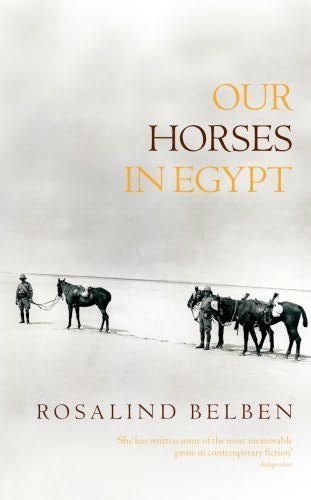
This year's winner of the fiction award was Our Horses in Egypt by Rosalind Belben (UK).
The book features parallel stories: Philomena, an English hunting horse of no particular distinction, is requisitioned by the British army in World War I and shipped to Egypt to become a military mount, and Griselda, her former owner, a young woman widowed by the war, sets off on an eccentric mission to Egypt (with her six year old daughter and nanny in tow) to recover Philomena.

The other shortlisted books were: The Devil's Footprints by John Burnside (UK), The Reluctant Fundamentalist by Mohsin Hamid (Pakistan / UK), A Far Country by Daniel Mason (USA) and Salvage by Gee Williams (UK). It seems clear at this point that The Reluctant Fundamentalist is receiving very good reviews and I look forward to reading it. The plot of A Far Country by Daniel Mason, the only American writer shortlisted, also looked interesting, but The New York Times gave it a bad review. I guess that a Western author writing about a third-world country isn't fashionable anymore!

Wednesday, August 13, 2008

Do you want to read Down Under?

My loyal friend guardian.co.uk published an article featuring the shortlist of the first edition of the richest (in terms of $$$) literary award in Australia. What is odd is that the final decision on the winner is to be made by Australian Prime Minister Kevin Rudd, after reccomandations from the judges of course. This is why the prize is called Australian Prime Minister’s Literary Award. Apart from the fact that I strongly doubt that a Prime Minister will have the time to read 14 books over the next few months, does he really know something about how to write a good book? Here’s the lsit of the 7 fiction books chosen:
  • Burning In by Mireille Juchau: Martine, a photographer in her late twenties, is leaving Sydney and moving to New York for reasons far more complex than her artistic career. Not only leaving her country behind, she’s also on the run from an ageing and lonely mother named Lotte, a Holocaust survivor, who over the years has become increasingly dependent on Martine.
  • El Dorado by Dorothy Porter: In Dorothy Porter's verse novel, a serial killer who gets his poems published in The Age, tough cops, cool teenagers and some oddly matched lovers propel an assonance-driven narrative.
  • Jamaica: A novel by Malcolm Knox: Six friends head for Jamaica to take part in the Negociante Classic, a notoriously tough and dangerous deep-water swimming race.
  • Sorry by Gail Jones: In the remote outback of North-west Australia, English anthropologist Nicholas Keene and his wife Stella raise a curious child, Perdita. Her childhood is far from ordinary; a shack in the wilderness, with a distant father burying himself in books and an unstable mother whose knowledge of Shakespeare forms the backbone of the girl's limited education. Emotionally adrift, Perdita develops a friendship with an Aboriginal girl, Mary, with whom she will share a very special bond. She appears content with her unusual family life in this remote corner of the globe until Nicholas Keane is discovered murdered.
  • The Complete Stories by David Malouf: ‘Here are the Aussie battlers in isolated hamlets, the sons of missing fathers, the mothers of outsize broods and the old women whose memories have led them into a kind of dreamtime. Reading these rich, beautifully wrought stories, you can almost smell the ti trees and hear the screeching as the cockatoos take flight.’ – The New York Times
  • The Widow and Her Hero by Tom Keneally: When Grace married the genial and handsome Captain Leo Waterhouse in Australia in 1943, they were young, in love - and at war. Being abandoned isn't the perfect idea of a marriage, yet Grace cannot quell her admiration for her husband. He is a volunteer on a dangerous mission - sink Japanese shipping in Singapore harbour. The team he's with has done it once, will a second go be as successful?
  • The Zookeeper's War by Steven Conte: another war story. It is 1943 and each night in a bomb shelter beneath the Berlin Zoo an Australian woman, Vera, shelters with her German husband, Axel, the zoo's director. Together, they struggle to look after the animals through the air raids and food shortages. When the zoo's staff is drafted into the army, forced labourers are sent in as replacements. At first, Vera finds the idea abhorrent, but gradually she realises that the new workers are the zoo's only hope, and forms an unlikely bond with one of them.
15/09 Sorry for the previous mistakes with the plots. The plots for The Widow and Her Hero and The Zookeeper's War should now be correct. The irony is that The Zookeeper's War is the winner of the prize.

Wednesday, July 30, 2008

Man Booker Prize Longlist 2008

Here’s the Man Booker Prize longlist for 2008. Quite predictably, Superstar Rushdie is there. Kureishi, Carey and Lessing were not as lucky. There are some first-time novelists (5), but also ‘old glories’ (Amitav Ghosh, John Berger). Despite the fact that the judges claim to have reached a good geographical balance, there are no Caribbean or African writers on the list. Of course, this should represent the best of this year’s Commonwealth fiction in English, regardless of the country of origin. I wonder if the geographical spread is actually a factor in their decision making or if the judges simply choose the best works of fiction.

Since we’re talking of the Booker Prize, all novels are worth reading. Judging from the synopsis, De Kretser’s and Hanif’s novels are the ones I really look forward to read. My wanna read choices are in violet, as usual.

  • The White Tiger by Aravind Adiga (India): Indian stories are always appealing these days;
  • Girl in a Blue Dress by Gaynor Arnold (UK)
  • The Secret Scripture by Sebastian Barry (Ireland)
  • From A to X by John Berger (UK): it hasn’t been published yet, but it looks tempting;
  • The Lost Dog by Michelle de Kretser (Australia / Sri Lanka): already on ‘The Guardian’’s reading list, the buzz of the year;
  • Sea of Poppies by Amitav Ghosh (India)
  • The Clothes on Their Backs by Linda Grant (UK): London Jewish family in the 1970s, interesting;
  • A Case of Exploding Mangoes by Mohammad Hanif (Pakistan): quirkily interesting;
  • The Northern Clemency by Philip Hensher (UK)
  • Netherland by Joseph O'Neill (Ireland): 9/11 novel set in the USA;
  • The Enchantress of Florence by Salman Rushdie (India / UK): I swear I’m not gonna read this before Midnight’s Children, plus I’m beginning to be a bit fed up with Mr Rushdie. He’s everywhere!
  • Child 44 by Tom Rob Smith (UK)
  • A Fraction of the Whole by Steve Toltz (Australia)

Saturday, July 19, 2008

Check out 'The Guardian'’s Summer Reading List

Here's the link to the article, if you want to read it yourself. I already have a Summer Reading List (more or less), so this might become a part of my autumn reads. To be noted that, as far as I can see, all these books were written in English. Is The Guardian biased against non-Anglophone authors? Or do Anglophone readers tend to read only fiction written in their own language? However, there are some books that I plan to read here (in violet):

  • De Niro's Game by Rawi Hage (Lebanon / Canada): ‘a searing account of life in war-torn Beirut, brutal and poetic by turns’;
  • The Gathering by Anne Enright (Ireland): Booker Prize winner;
  • When We Were Bad by Charlotte Mendelson (UK);
  • According to Ruth by Jane Feaver (UK);
  • The Voluptuous Delights of Peanut Butter and Jam by Lauren Liebenberg (Zimbabwe / South Africa): a journey into childhood's foreign country - and the dying days of Rhodesia. Postcolonial stuff: must be mine.
  • Born Yesterday: The News as a Novel by Gordon Burn (UK);
  • The Reluctant Fundamentalist by Mohsin Hamid (Pakistan / UK): shortlisted for the Booker Prize, wanna read.
  • The Enchantress of Florence by Salman Rushdie (India /UK): I’m not gonna read this before Midnight’s Children, even though it is set in Italy;
  • The Collected Stories of Lorrie Moore by Lorrie Moore (USA);
  • Unaccustomed Earth by Jhumpa Lahiri (India /USA): I’ll probably read this, hoping it will be a second Namesake;
  • The Lost Dog by Michelle de Kretser (Australia / Sri Lanka): tipped for the Booker;
  • The Brief Wondrous Life of Oscar Wao by Junot Diaz (USA / Dominican Republic): already in my TBR list;
  • The Point of Rescue by Sophie Hannah (UK);
  • End Games by Michael Dibdin (UK);
  • Bleeding Heart Square by Andrew Taylor (UK);
  • Revelation by CJ Sansom (UK);
  • Darkmans by Nicola Barker (UK);
  • Ascent by Jed Mercurio (UK);