Sunday, March 21, 2010

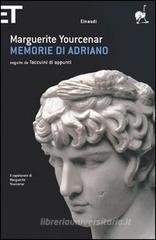
50. “Memorie di Adriano” di Marguerite Yourcenar [Italian version]


Anno di prima pubblicazione: 1951
Genere: romanzo storico, memorie
Paese: Francia / Belgio

En français: Mémoires d’Hadrien de Marguerite Yourcenar

Marguerite Yourcenar provò a scrivere questa storia per molto tempo, ma era costantemente insoddisfatta del risultato. Era un po’ come Flaubert, che riscriveva la stessa pagina molte volte. Ed è proprio una citazione di Flaubert che la Yourcenar usa, nei suoi appunti alla fine del volume, per dirci perché ha scelto di scrivere sull’imperatore Adriano: “Quando gli dèi non c’erano più e Cristo non ancora, tra Cicerone e Marco Aurelio, c’è stato un momento unico in cui è esistito l’uomo, solo”.
L’autrice parte dall’idea di prendere la vita di un grande della storia, di creare un’autobiografia fittizia che narra la vita dell’uomo a ritroso, guardando indietro ai giorni vissuti. Marguerite Yourcenar ci riporta così al secondo secolo d.C. nella vita dell’imperatore Adriano, nella sua vecchiaia, quand’era stanco e malato, ma non aveva smesso di apprezzare la vita. Adriano era un filantropo, un filosofo e, naturalmente, un grande statista. Con questo libro arriviamo a conoscere la vita quotidiana di un imperatore romano, le sue preoccupazioni e le sue passioni. Dall’infanzia in quella che ora si chiama Spagna, allora una provincia dell’impero, alla morte di Traiano, che lo designò come suo successore in punto di morte, Adriano ricorda la sua vita, cercando di afferrare il significato ultimo della sua esistenza. Aveva avuto un’educazione greca ed era un ammiratore della cultura ellenica, perciò gli veniva naturale filosofeggiare, ragion per cui il romanzo è soprattutto un romanzo sulla filosofia.
E’ noto che Adriano ebbe una storia romantica con un giovane greco chiamato Antino, che annegò misteriosamente nel Nilo. Afflitto dalla perdita, Adriano fondò la città di Antinopoli. Ecco quindi che Memorie di Adriano diventa anche un libro sull’amore e sulla perdita, e poco importa che si trattasse di un amore omosessuale. Sullo sfondo ci sono le campagne di Adriano (in Giudea o in Britannia, per esempio) e la sua preoccupazione di trovare un successore.
La lingua misurata e la prosa fluida rendono prezioso questo libro, ma bisognerebbe leggerlo più di una volta per apprezzarlo davvero. Memorie di Adriano va assaporato, letto lentamente e forse riletto ad un’età più matura.


Sull’autrice: Marguerite Yourcenar nacque a Bruxelles, Belgio, nel 1903, da padre francese aristocratico e madre belga. Sua madre morì dieci anni dopo la sua morte, perciò fu cresciuto dalla nonna paterna e dal padre, un grande viaggiatore. Il suo primo romanzo, Alexis, fu pubblicato nel 1929 ed è ispirato ad André Gide, un famoso scrittore francese, omosessuale dichiarato. Narra di un uomo che confessa la sua omosessualità a sua moglie e perciò decide di lasciarla. Dopo la morte del padre, avvenuta nel 1929, Marguerite Yourcenar fece vita “bohémienne” tra Parigi, Istanbul, Bruxelles e la Grecia. Era bisessuale e aveva relazioni sia con uomini che con donne. Pubblicò Nouvelles Orientales nel 1938, un racconto dei suoi viaggi. Nel 1939, trovandosi senza denaro e con la prospettiva di una guerra, raggiunse la sua amante, Grace Frick, negli Stati Uniti. Vissero insieme a Mount Desert Island, Maine, fino alla morte della Frick nel 1979. Marguerite Yourcenar diventò cittadina americana nel 1947. Nel 1951 pubblicò Memorie di Adriano, che stava scrivendo da una decina d’anni, e il libro fu un immediato successo di pubblico e di critica.

50. “Memoirs of Hadrian” by Marguerite Yourcenar [English version]


Year of first publication: 1951
Genre: historical novel, memoir
Country : France / Belgium

En français: Mémoires d’Hadrien de Marguerite Yourcenar

Marguerite Yourcenar tried to write this story for a long time, but she was constantly unsatisfied with the result. She was sort of like Flaubert, who rewrote the same page over and over again. And it is indeed a quote from Flaubert that Yourcenar uses, in her notes at the end of the volume, to tell us why she chose to write about Emperor Hadrian: “When the gods were no more and Christ not yet there, between Cicero and Marcus Aurelius, there was a unique moment in which only man existed, alone” (my translation).
The author starts from the idea of taking the life of a great man in history, of creating a fictional autobiography that narrates the man’s life in retrospective, looking back at the past days. Marguerite Yourcenar takes us back to the II century AD into the life of Emperor Hadrian, into his old age, when he was tired and ill, but didn’t stop appreciating life. Hadrian was a philanthropist, a philosopher and, of course, a great statesman. With this book we get to know the everyday life of a Roman Emperor, his preoccupations and his passions. From his childhood in what is now called Spain, then a province in the Roman Empire, to the death of Emperor Trajan who designated him as his successor on his death bed, Hadrian remembers his life, trying to grasp the ultimate meaning of his existence. He had a Greek education and was an admirer of Greek culture, so it was natural for him to indulge in philosophy, therefore the book is first of all about philosophy.
Hadrian notoriously had a romantic relationship with a Greek youth called Antinous, who mysteriously drowned in the Nile. Saddened by this loss, Hadrian founded the city of Antinopolis. Memoirs of Hadrian therefore also becomes a book about love and loss, and it doesn’t really matter that it was a same-sex relationship. In the background there are Hadrian’s campaigns (in Judea or in Britannia, for instance) and his preoccupations to find a successor.
The measured language and the fluent prose make this book precious, but one that you’d need to read more than once to really appreciate. Memoirs of Hadrian needs to be savoured, read slowly and maybe reread at an older age.

About the author: Marguerite Yourcenar was born in Brussels, Belgium, in 1903 to a French aristocratic father and a Belgian mother. Her mother died ten years after her birth, so she grew up with her paternal grandmother and her father, a great traveller. Her first novel, Alexis, was published in 1929 and it was inspired by André Gide, a famous French writer and a declared homosexual. It is about a man who confesses his homosexuality to his wife and therefore decides to leave her. After the death of her father in 1929, Marguerite Yourcenar led a bohemian life between Paris, Istanbul, Brussels and Greece. She was bisexual and had relationships with both men and women. She published Nouvelles Orientales in 1938, a recount of her travels. In 1939, finding herself out of money and in the prospect of a war, she joined her lover, Grace Frick, in the United States. They lived together in Mount Desert Island, Maine, until Frick’s death in 1979. Marguerite Yourcenar became an American citizen in 1947. In 1951 she published Mémoires d’Hadrien, which she had been writing for a decade, and the book was an immediate success of critic and public.

Thursday, March 18, 2010

Have fun with Book Review Bingo!

Have you ever noticed that book reviews always use the same words? Of course you have, since you are reading a blog that offers book reviews! To my excuse, I can say that English is not my first language and my vocabulary is not as vast as I'd like it to be. Now you can play Book Review Bingo with the overused adjectives while you're reading your book reviews! How funny! I'm culpable of using many of these words myself, here's the list:

compelling
beautifully written
lyrical
in the tradition of
rollicking
tour de force
thought-provoking
at once
haunting
riveting
nuanced
x meets x
cliché-free
stunning
epic
pitch-perfect
readable
timely
unputdownable
that said
gritty
powerful
sweeping
unflinching
fully-realised

What I'm going to do is find out how the bingo would come out in Italian. I'll browse through let's say 100 book reviews from magazines and semi-official blogs in search of over-used adjectives (of course I already have an idea) and then I would check my own reviews in Italian (of course there's not one hundred). "Avvincente" and "appassionante" will most likely make you win the "tombola" (bingo), as they are the Italian counterparts of words like compelling and gripping. The problem with Italian reviews is that for some reason reviewers, even professional ones, don't express their personal opinions and reactions as much as English-speaking reviewers do. They are comfortable with only one or two adjectives that express their opinions per review. By doing this, I think, you fail to give a complete review! You might as well read the back cover of the book and you'd get the same result!

Sunday, March 14, 2010

49. “Blonde Roots” by Bernardine Evaristo


Year of first publication: 2008
Genre: novel, dystopian novel, fantasy novel, satirical novel
Country: UK

Doris Scagglethorpe lives in a cottage with her family in England. One day she is kidnapped and put aboard a slave ship bound for an imaginary country called New Ambossa. In a photographic negative of the slave trade, Bernardine Evaristo imagines what would have happened if the “whyte Europanes” were enslaved by “blak Aphrikans”. After experiencing the horrors of the Middle Passage, Doris becomes the playmate of a spoilt Ambossan brat called Little Miracle. Ambossans are rich and powerful: the women show with pride their plaited hair and their big bottoms, while the men go naked even when they are “hunting for Europanes” on the Cabbage Coast of England. This is of course because they can’t accept to wear the warm clothes of the Europanes, whom they consider inferior. Ambossans are in fact regarded as more sophisticated and African culture is universally considered more developed. Europanes, on the other hand, are barbaric people, who live in primitive square houses and have ridiculous customs, like that of having pets.
Doris, now renamed Omorenomwara in spite of her, works for Chief Kaga Konata Katamba I, who also has a huge plantation with whyte slaves in the New World. The second part of the novel is in fact set in a plantation ironically called Home Sweet Home, where Doris is sent to work as a slave. Here, there is a whole community of whyte slaves who speak “patois” and mix Europanes and Afrikan customs. Doris tries to escape twice and in one of her “runs for freedom” she walks through the city of Londolo, where the disused underground now serves as a clandestine way to escape from slavery. In the “Vanilla Suborbs” of Brixtane freed whytes spend hours trying to have an Aphro or have cheap nose-flattening jobs, while blak people shout “Go home, you’re stealing our jobs!”.
Evaristo worked really well with the language (she has a poetry background), giving an African twist to place names and English words. Despite being so innovative and postmodern, the book is reminiscent of Swift’s satire, with the same caricatures that made him famous.
Very humorous, but also very bitter at times, Blonde Roots, which is and adaptation of Alex Haley’s 1976 novel Roots, tells us of the horrors of the slave trade in a different way. While you’re reading it, you keep forgetting that Doris is white and her cruel master black. This helps you understand how things could have been easily reversed, had history taken a different turn. Evaristo mixes the historical into the contemporary, creating a dystopian novel that is very easy to read and engaging. It is nonetheless a very painful read, as other great novels about slavery are (I only name Toni Morisson’s Beloved, one of my all-time favourites).
My only criticism is a couple of unlikely coincidences and the confusing change of global geography (why should Europe be moved on the southern emisphere and Ambossa, which has the shape of England, placed off the African coast?), but overall it is an enjoyable novel.


About the author: Bernardine Evaristo was born in London to an English mother and a Nigerian father, the fourth of eight siblings. She is the author of three critically-acclaimed novels in verse: Lara (1997), The Emperor’s Babe (2001) and Soul Tourists (2005). Lara traces the roots of a mixed-race English-Nigerian-Brazilian-Irish family over 150 years. Her second novel tells the story of Zuleika, girls of Sudanese parentage, who grows up in Roman London 1800 years ago and who has an affair with Roman Emperor Septimius Severus. Soul Tourists is about a car journey across Europe straring a mismatched couple, with cameo appearances en route from ghosts of colour from European history such as Pushkin, Alessandro De Medici and Mary Seacole. Blonde Roots (2008) is her first novel in prose.

Friday, March 12, 2010

Commonwealth Writers' Prize + Man Asian rules changed

Commonealth Writers Prize: shortlist for regional winners has been announced. I'm happy for Albert Wendt in the South East Asia and Pacific region. He's a Samoan writers who also works and writes in New Zealand. I read a couple of hi short stories and they were really good. When I have time, I will browse the web looking for plots and interesting books...

Africa
The shortlisted writers for Africa's Best Book are:
Trespass by Dawn Garisch (South Africa)
The Double Crown by Marié Heese (South Africa)

The Thing Around Your Neck by Chimamanda Ngozi Adichie (Nigeria)
Eyo by Abidemi Sanusi (Nigeria)
Tsamma Season by Rosemund Handler (South Africa)
Refuge by Andrew Brown (South Africa)
Kings of the Water by Mark Behr (South Africa)

The shortlisted writers for Africa's Best First Book are:
I Do Not Come to You by Chance by Adaobi Tricia Nwaubani (Nigeria)
The Shape of Him by Gill Schierhout (South Africa)
The Shadow of a Smile by Kachi Ozumba (Nigeria)
Come Sunday by Isla Morley (South Africa)
Sleepers Wake by Alistair Morgan (South Africa)
Jelly Dog Days by Erica Emdon (South Africa)
Harmattan Rain by Aysha Harunna Attah (Ghana)

Caribbean and Canada
The shortlisted writers or the Caribbean and Canada Best Book are:
The Winter Vault by Anne Michaels (Canada)
February by Lisa Moore (Canada)
Euphoria by Connie Gault (Canada)
Goya's Dog by Damian Tarnopolsky (Canada)
Galore by Michael Crummey (Canada)
The Golden Mean by Annabel Lyon (Canada)

The shortlisted writers for the Caribbean and Canada Best First Book are:
Under this Unbroken Sky by Shandi Mitchell (Canada)
Daniel O'Thunder by Ian Weir (Canada)
The Island Quintet: Five Stories by Raymond Ramcharitar (Trinidad)
Diary of Interrupted Days by Dragan Todorovic (Canada)
The Briss by Michael Tregebov (Canada)
Amphibian by Carla Gunn (Canada)


South Asia and Europe
The shortlisted writers for South Asia and Europe Best Book are:
Solo by Rana Dasgupta (Britain)
For Pepper and Christ: A Novel by Keki Daruwalla (India)
The Beijing of Possibilities by Jonathan Tel (Britain)
Heartland by Anthony Catwright (Britain)
Another Gulmohar Tree by Aamer Hussein (Pakistan)
The Immortals by Amit Chaudhuri (India)

The shortlisted writers for South Asia and Europe Best First Book are:
The Hungry Ghosts by Anne Berry (Britain)
Arzee the Dwarf by Chandrahas Choudhury (India)
In Other Rooms, Other Wonders by Daniyal Mueenuddin (Pakistan)
Among Thieves by Mez Packer (Britain)
An Equal Stillness by Francesca Kay (Britain)
Tail of the Blue Bird by Nii Parkes (Britain)


South East Asia and Pacific
The shortlisted writers for South East Asia and Pacific Best Book are:
Summertime by J.M Coetzee (Australia)
A Good Land by Nada Awar Jarrar (Australia)
The Adventures of Vela by Albert Wendt (Samoa)
Singularity by Charlotte Grimshaw (New Zealand)
The People's Train by Thomas Keneally (Australia)
Parrot and Oliver in America by Peter Carey (Australia)

The shortlisted writers for South East Asia and Pacific Best First Book are:
The Ice Age by Kirsten Reed (Australia)
After the fire, a still small voice by Evie Wyld (Australia)
Look Who's Morphing by Tom Cho (Australia)
Document Z by Andrew Croome (Australia)
Come Inside by Glenys Osborne (Australia)
Siddon Rock by Glenda Guest (Australia)


Do yo remember the Man Asian Literary Prize? I wrote about it a few times. It’s supposed to help English-speaking readers to discovers Asian literature, promoting books unpublished in English, which means that they might have written in another language, let’s say Chinese or Thai.
Great thing, except that now the rules have changed. A blogger friend from Malaysia, Sharon of Bibliobibuli, wrote about it with more details. Well, to sum it up now the prize is opened only to novels first published in English in 2010… so forget about those countries whose literature you wanted to get your hands to. No more Vietnam or Myanmar, Sharon says.

Tuesday, March 9, 2010

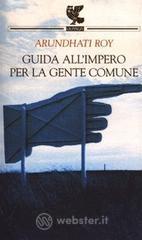
48. “Guida all’Impero per la Gente Comune” di Arundhati Roy [Italian version]


Anno di prima pubblicazione: 2002-2003
Genere: saggistica
Paese: l’autrice è indiana, ma gli articoli hanno anche a che fare con altri paesi, come l’Iraq, l’Afghanistan e il Pakistan

La mia recensione di Guida all’Impero per la Gente Comune è uscita in italiano sulla rivista culturale Paper Street ed è disponibile a questo link. Per non ripetermi, scriverò un po’ più in generale dell’autrice e di un recente risvolto del suo attivismo politico.

Arundhati Roy la cannibale, Arundhati Roy la hooligan. Alcuni la odiano e altri la amano. Io sono tra quelli che l’amano, sebbene non sia sempre d’accordo con lei. Per esempio quando, in un recente articolo pubblicato su Outlook India (pubblicato anche con il titolo “La guerra nel cuore dell’India” su Internazionale n.821, 13/19 Novembre 2009) , giustifica i ribelli maoisti, un gruppo di guerriglieri che sta dando numerosi problemi al governo indiano. Secondo me, il problema non è se queste persone abbiano ragione o no (naturalmente hanno ragione a non volere che le loro terre vengano sfruttate ed espropriate), il problema è che usano la violenza e il terrorismo per farlo. Roy ha per caso dimenticato il “metodo non-violento gandhiano” che ha portato il suo paese all’indipendenza? E’ arrivata alla conclusione che è fuori moda ed inutile digiunare e scioperare per i propri diritti di questi tempi? La violenza porta solo ad altra violenza: “occhio per occhio e tutto il mondo diventa cieco” diceva Gandhi. Per di più, tutti i gruppi di guerriglia che mi vengono in mente (le FARC colombiane o gli Shan in Birmania) hanno cominciato come idealiste e poi hanno finito per usare metodi illegali come il traffico di droga per finanziarsi, curandosi sempre meno dei loro scopi originali.
A parte i miei disaccordi personali con alcune delle sue opinioni, quello che ti fa ammirare questa quarantottenne indiana magrolina che vuole cambiare il mondo è che usa la scrittura come un’arma. E’ la passione che ci mette in quello per cui lotta e per cui crede che ti fa leggere con trepidazione ogni articolo che scrive, anche si tratti di qualcosa di distante dalla nostra vita di tutti i giorni come i gruppi tribali indiani. E la mia ammirazione per lei non è stata scalfita da questo esito inaspettato del suo attivismo.
Guida all’Impero per la Gente Comune è una collezione di saggi di Arundhati Roy scritti tra il 2002 e il 2003, nel periodo successivo all’11 settembre. Lungi da sembrare datati, gli articoli riguardano la relazione tra i potenti e le persone comuni, impotenti e sfruttate da quelli che detengono il potere. Che siano talebani, un gruppo tribale indiano o cittadini americani poco importa, ad Arundhati Roy importa delle persone comuni, ed è evidente nel suo difendere i ribelli maoisti, che sono persone comuni privare della loro terra.
Ora i ribelli maoisti hanno chiesto ad Arundhati Roy di mediare con il governo. Roy ha rifiutato naturalmente, dicendo che lei è una scrittrice e non ha le capacità di un mediatore. Invece spera in un cessate il fuoco di entrambe le parti. Perciò mi chiedo se Arundhati Roy di fatto approvi i mezzi usati dai maoisti per ottenere quello che vogliono, in assenza di alternative, oppure è d’accordo soltanto con la loro causa? Perché mi sembrava che, almeno dall’articolo sopraccitato, non stesse solo sostenendo la loro causa, ma stesse anche giustificando i loro atti di violenza nel nome di “un bene più grande”.

48. “The Ordinary Person’s Guide to Empire” by Arundhati Roy [English version]


Year of first publication: 2002-2003
Genre: non-fiction
Country: the author is Indian, but the essays also deal with other countries such as Iraq, Afghanistan and Pakistan.

My review of The Ordinary Person’s Guide to Empire has appeared in Italian on the cultural magazine Paper Street and it’s available at this link. In order not to repeat myself, even if in another language, I will write more in general about the author and about a recent outcome of her political activism.

Arundhati Roy the cannibal, Arundhati Roy the hooligan. Some people hate her and some people love her. I’m among those who love her, even though I don’t always agree with her. For example when, in a recent article published in Outlook India, she justified the Maoist rebels, a guerrilla group that is giving a lot of troubles to the Indian government. In my opinion, the problem is not whether or not these people are right (of course they’re right in wanting their lands not to be exploited and expropriated), the problem is that they use violence and terrorism to do that. Has Roy forgotten the “Gandhian non-violent approach” that led her country to independence? Has she come to the conclusion that it’s old fashioned and useless to fast and strike for your rights in times like these? Violence only lead to more violence; “an eye for an eye makes the whole world blind” Gandhi used to say. Moreover, all the guerrilla groups I can think of (the Colombian FARC or the Shan in Burma) started off as idealistic and ended up using illegal activities like drug smuggling to finance themselves, caring less and less about their original aims.
Apart from my personal disagreements with some of her opinions, what makes you admire this 48-year-old skinny Indian woman who wants to change the world is that she uses writing as a weapon. It’s the passion that she puts in what she fights for and believes in that makes you read with trepidation every article that she writes, even if it’s about something very distant from your everyday life as the tribal groups of India. And my admiration for her has not been touched by this unexpected outcome of her activism.
The Ordinary Person’s Guide to the Empire is a collection of essays by Arundhati Roy written in 2002-2003 on the aftermath of 9/11. Far from sounding dated, the essays are about the relationship between the powerful and ordinary people, helpless and exploited by those who detain the power. Whether they are Talibans, a tribal group of India or American citizens, ordinary people are what matters for Roy and this is evident in her defence of the Maoist rebels, who are ordinary people deprived of their lands.
Now the Maoist rebels have asked Roy to mediate with the government. Roy has of course rejected the offer, on the grounds that she is a writer and she doesn’t have the skills of a mediator. She hopes for a ceasefire on both sides, instead. So does Arundhati Roy actually support the Maoist’s means to get what they want in absence of alternative ways or does she only agree with the cause? Because it seemed to me that, at least from the article aforementioned, she was not only advocating their cause, but also justifying their acts of violence in name of “a greater good”.