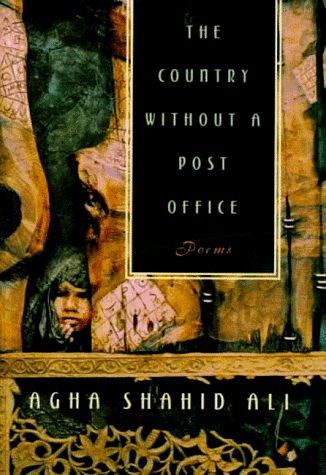
In the case of Agha Shahid Ali (1949 – 2001), the entry about the author’s country that I usually have at the beginning of every review makes me feel ill at ease, so I decided to leave that out. We are speaking of a Kashmiri-American poet, born in New Delhi in a newly independent India and forced into exile in the United States because of the violent reality of Kashmir, which was annexed to a mostly Hindu nation, India, even if it was a predominantly Muslim region also claimed by Pakistan. To express this uneasiness, the poet uses among other things the metaphor of stamps (“I’ve brought cash, a currency of paisleys / to buy the new stamps, rare already, blank, / no nation named on them”).
The country without a post office in the title is obviously Kashmir, written in endless ways (“Kashmir, Kaschmir, Cashmere, Qashmir, Cashmir…”) to stress the elusiveness of the places of memory, which in the meantime change but in our minds are still as we left them, even though faded and distorted by the present time we live in. In Kashmir, incidentally, several layers created by migrations, conquests and conversions have set up a multiplicity of meanings, mirrored in the name of the region and in its different transliterations. These layers, superimposed but also cause of frictions and fractures, perfectly describe the poems of Agha Shahid Ali. Outlining it, Meena Alexander speaks of a “geography of dissonance, place tearing open to reveal another place, an elsewhere the poet must claim in order to reach where he wants to go” (Poetics of Dislocation, p.9). It is thus possible that the phone rings in America and, when the conversation has finished, you hang up the phone in Kashmir, as it happens in the poem that gives its name to the entire collection.
Those who in front of a poem always feel the urgency to understand should take note that Agha Shahid Ali’s poetry is built through associations rather than through a concrete narrative plot. Yet the poet often speaks of real events, like when in 1990 the post office of Srinagar closed down for several months because of violent insurrections against the government and the mail piled up in the house of a friend of the poet’s father.
Agha Shahid Ali’s poetry is packed with nostalgia and awareness of the fact that once you have left the native country and one’s past are irretrievable. The dreamlike quality of his poetry are triggered by this desire to grasp, to own once again the places of childhood and one’s roots. Yet it is a desire accomplished only in brief moments when several places superimpose, or in dreams, which obstinately and unreasonably bring us back to the places we have lived in, distorting them and adapting them to the concrete reality of the present. Exile, for the poet, is like the Arab language, used in prayer by all Muslims, but not always possessed or understood. In the couplets of a ghazal, Agha Shahid Ali expresses these feelings:
The only language of loss left in the world is Arabic –
These words were said to me in a language not Arabic.
[…]
From exile Mahmoud Darwish writes to the world:
You’ll all pass between the fleeting words of Arabic.
At an exhibition of miniatures, such delicate calligraphy:
Kashmiri paisleys tied into the golden hair of Arabic!
[…]
When Lorca died, they left the balconies open and saw:
his qasidas braided on the horizon, into knots of Arabic.
(“Ghazal”)

Agha Shahid Ali has introduced Americans to the poetic form of the ghazal, through his works and his translation of the great Urdu poet Faiz Ahmed Faiz. Some American poets, after him, have experimented with this poetic form in English, as García Lorca had done before with Spanish. Ali said that every couplet, repeating in its second verse the rhyme in the first couplet, is like a stone from a necklace, which should continue to shine in that vivid isolation.
This is the kind of poetry that has apt quotations, sometimes from poets also interested in the problems of nationalism and self-rule, for instance Yeats “Now and in time to be / Wherever green is worn, … / A terrible beauty is born”), or from cherished poets, like Emily Dickinson who lived in Amherst like him. Of her he reports a few lines at the beginning of a poem (“If I could bribe them by a Rose / I'd bring them every flower that grows./ From Amherest To Cashmire”). In spite of this he has an extremely original style: he uses free verse as well as some specific poetic forms (villanelle or ghazal, for instance), thus mixing several poetic traditions. He speaks of utterly personal feelings and experiences of loss and nostalgia, but he also reflects on the ultimate meaning of history and of human conflicts.
This is the kind of poetry that has apt quotations, sometimes from poets also interested in the problems of nationalism and self-rule, for instance Yeats “Now and in time to be / Wherever green is worn, … / A terrible beauty is born”), or from cherished poets, like Emily Dickinson who lived in Amherst like him. Of her he reports a few lines at the beginning of a poem (“If I could bribe them by a Rose / I'd bring them every flower that grows./ From Amherest To Cashmire”). In spite of this he has an extremely original style: he uses free verse as well as some specific poetic forms (villanelle or ghazal, for instance), thus mixing several poetic traditions. He speaks of utterly personal feelings and experiences of loss and nostalgia, but he also reflects on the ultimate meaning of history and of human conflicts.
About the author: Agha Shahid Ali was born in New Delhi in 1949. He was educated there and in Kashmir, before emigrating to America. There he was the recipient of several grants. He is the author of, among other things, "A Nostalgist's Map of America" (1991), "Call me Ishmael Tonight: A book of ghazals" (2003) and "The Country Without A Post Office" (1998). He also edited a book of ghazals in English, "Ravishing Disunities: Real Ghazals in English" (2000). He died of brain cancer in 2001.
