Showing posts with label Jackie Kay. Show all posts

Sunday, May 1, 2011

"Trumpet" di Jackie Kay + "Scintille" di Gad Lerner

Vi aggiorno su un paio di cose. Sono uscite un paio di mie recensioni sulla rivista Paper Street: lo scorso mese quella di "Trumpet" di Jackie Kay, la poetessa di cui ho parlato anche qui. E' un libro che è stato tradotto in Italia, una volta tanto, e io ve lo consiglio caldamente, anche se per ottenerlo dovrete quasi certamente ordinarlo in libreria.

"Pilgrims" di Bruno Schulz
Questo mese ho scritto invece la recensione di "Scintille. Una storia di anime vagabonde" di Gad Lerner. Su quest'ultimo vorrei spendere due parole su qualcosa che non ci stava nella recensione per gli amici di Paper Street. Lerner si sofferma sulla pittura di Bruno Schulz, che potrebbe avere incrociato suo nonno nelle cittadine della Galizia yiddish dove entrambi  vivevano. Questo scrittore e pittore, che io prima non conoscevo se non di fama, dipingeva/schizzava queste cose sinceramente angoscianti ed inquietanti. I suoi soggetti erano molto spesso vecchiacci malefici con teste sproporz
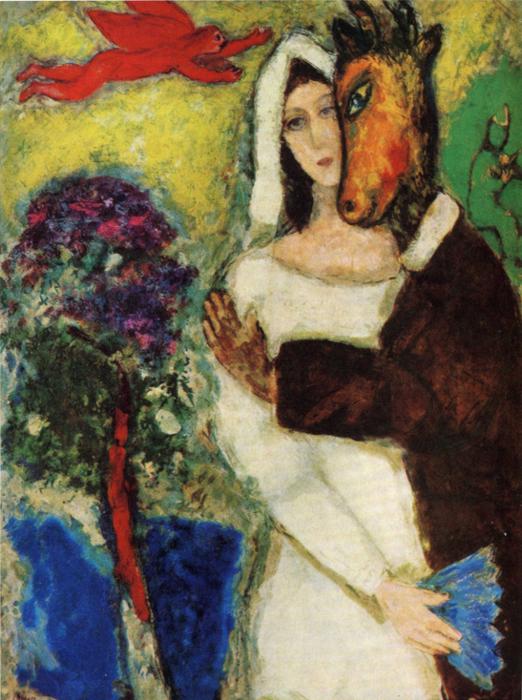
"Midsummer Night's Dream" di Marc Chagall
ionate e calvizie incipiente, al cospetto di donne dalle gambe snelle in pose lascive. Lerner spiega la cosa con il complesso di inferiorità del povero Schulz, non certo bello e del tutto simile a questi uomini che non potevano far altro che fissare le proverbiali bellezze ucraine (che incantano anche Lerner nel libro, eh!?), e naturalmente con la nota 'sgradevolezza ebraica'. Mi soffermo a pensare a questa sgradevolezza, ohibò! Poi giro la testa e vedo una stampa di Marc Chagall che mi hanno regalato, sensibilità completamente diversa ma uguali natali, se non fosse che... Ma come? Tu quoque, Marc, fili mi! Ma poi no, per fortuna mi sono ricordata che il titolo del quadro è "Midsummer Night's Dream"!!! Chagall è ancora il pittore degli abbracci romantici...

Mi riallaccio all'ambientazione mediorientale del libro di Gad Lerner, per dirvi che ho conosciuto un amico blogger, che scrive sulla Turchia dall'affascinante città di Istambul. Io della Turchia, se non ricordo male avevo parlato solo in un post, molto molto tempo fa riguardo un romanzo di Orhan Pamuk.

Tuesday, March 29, 2011

Jackie Kay, 'Things Fall Apart'

Não tenho ambiçôes nem desejos 
Ser poeta não é uma ambição minha 
É a minha maneira de estar sozinho.
Fernando Pessoa ('O guardador de Rebanhos' in "Poemas Completos de Alberto Caeiro")

I don't have ambitions or desires
Being a poet isn't my ambition,
It's my way of being alone.
Fernando Pessoa ('The Keeper of Flock' in "Alberto Caeiro: The Complete Poems")

I never speak about poetry in my blog and I don't know why. I don't know if poetry works on the internet, where people come into a blog like this and read quickly a post in multitasking mode, hardly reaching the end of it. I'll try anyway.

I'll start with a poet some of you may not know. My intention is not to post Wordworth's "Daffodils"; for that you can go everywhere on the net. I want to post something that I find interesting, slightly different from the poems we are used to read in literature classes, and then write something about it.

The first poet I’d like to talk about is Jackie Kay. She was born in 1961 in Scotland, from a Nigerian father and a Scottish mother. She was adopted by a white couple and raised in Glasgow. She has written poetry ("The Adoption Papers", “Off Colour”, “Life Mask”), novels for both adults (“Trumpet”) and children (“Strawgirl”) and, more recently, a memoir (“Red Dust Road”). Some years ago she went to Nigeria to meet her biological father and had written a piece for the Guardian whose copyright is now expired. To know that story I guess you’ll have to read her memoir (I’m eager to, by the way, as I’ve read her novel “Trumpet” some years ago and loved it). Alternatively, you can read this poem:


Things Fall Apart


My birth father lifted his hands above his head
and put the white mask of God on his handsome face.

A born-again man now, gone were the old tribal ways,
the ancestral village - African chief's nonsense, he says.

I could see his eyes behind the hard alabaster.
A father, no more real, still less real - not Wole Soyinka.

Less flesh than dark earth; less blood than red dust.
Less bone than Kano camels; less like me than Chinua Achebe.

Christianity had scrubbed his black face with a hard brush.
'You are my past sin, let us deliberate on new birth.'

The sun slips and slides and finally drops
into the swimming pool, in Nico hotel, Abuja; lonely pinks.

I knock back my dry spritzer, take in the songs
of African birds. I think he had my hands, my father.


                                                                                (From "Life Mask", 2005)


I have chosen this poem, over several others by Jackie Kay, because it is highly resonant with names and tropes of postcolonial literatures: two great Nigerian writers are named, not to mention that the title immediately takes us back to the atmospheres of Achebe’s most important novel, “Things Fall Apart”. The discordance between expectations and real events is the main focus of this short poem. The old tribal ways swept away by the religion and the customs of the colonizers, as it happens in Achebe’s novel, are paired to her disappointment at a father she has long imagined and now that he is in front of her, in flesh and blood, looks like dark earth and red dust to her. Unable to reconcile her father with the figure of the Nigerian intellectuals she knows, she is finally left alone in the hotel and thinks of his father’s hands, so similar and dissimilar from hers, those same hands that were lifted above his head to take God's white mask and to put it on his handsome face (Frantz Fanon’s “Black Skin, White Masks” is the obvious reference here).

I like this poem for its simplicity, its refusal of the idea that poems use difficult words and complex figures of speech. It blends the narrative intent and the lyric moment, lending words in a most crystalline way to an emotion that we have all felt: disappointment and disenchantment.