Showing posts with label Nobel Prize in Literature 2008. Show all posts

Monday, September 14, 2009

Philip Roth on American Literature

Do you remember that a few months ago the permanent secretary of the Nobel Prize jury said that it was unlikely that an American author would be awarded the prize, because according to him "the US is too isolated, too insular", adding that "they don't translate enough and don't really participate in the big dialogue of literature"? He called this attitude a "restraining ignorance" (read my post and my opinions on the matter here).

Philip Roth, one of the most prominent living writers in the US, during an interview concerning his book Indignation, was asked what he thought about this. He answered (I'm translating Philip Roth back to English once that his words were translated into Italian in this article published in La Repubblica):

"It is such a ridiculous polemic that I can't even understand it. I think that American literature, from after the Second World War until now, has been the most important of the world, with authors like Faulkner, Hemingway and Bellow. And also nowadays we have top notch writers such as Don DeLillo, E. L. Doctorow, Cynthia Ozick, Joyce Carol Oates and Toni Morrison. I feel that I am in the company of excellent colleagues".

Take that Mr Engdahl!

But of course Mr Roth is himself an "isolated, insular" American, what does he know about world literature? :-P

Sunday, November 23, 2008

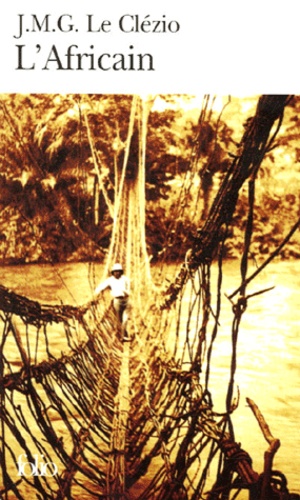
"L'Africain" by J.M.G. Le Clézio


Year of publication: 2004
Genre: biography, memoir
Setting and Time: Nigeria, Cameroon, France and Guyana, before and after the Second World War
Themes: Africa, family relationships, vocational jobs, colonialism

Nobel Prize in Literature 2008

About the author: read this post

What it’s all about: In this short book Le Clézio remembers his father, who was a “jungle doctor” first in Guyana and then in Cameroon and Nigeria. Here you can find his thoughts about his African childhood and about life in remote places.

Some thoughts: Can you start to understand why Le Clézio won a Nobel Prize by reading this nice little book? Not really. I mean, this is simply the account of the life of Le Clézio’s father as a doctor in various parts of the world, not a full-length novel. Of course, you can learn about his background and understand why he wrote about so many different parts of the world (sort of like Bruce Chatwin I would say).
The childhood of the Le Clézios in Africa is the antithesis of colonial life: they don’t have a big house with many servants (even though they have a “houseboy”) and they are the only white people in their village, so they are not enjoying the kind of life that Doris Lessing or Muriel Spark might recount about their African experience. There were a few fascinating things that he remembers about Africa, for example some of its animals and the life style of the people over there. The most interesting thing is how Le Clézio’s father is changed and shaped by his hard life in remote places of the world: when he goes back to France he is a real African man. There is nothing exotic in Le Clézio’s tale: his father led a lonely life in very isolated places and sometimes he had little human contact. Moreover, he lived with the frustration of not having the right medicines to cure the most common diseases of the villagers.
I’d like to read more about this author, as I’m not really in a position to say if he deserved the Nobel Prize or not. For the moment, I’m happy that I managed to read this small book in its original language and I can say that I quite enjoyed it.

Just click on the tag called Nobel Prize in Literature 2008 for some "musings" on this year's Nobel Prize Award.


Thursday, October 9, 2008

JMG Le Clézio wins Nobel Prize in Literature

The Swedish Academy announced that French novelist Jean-Marie Gustave Le Clézio has won the Nobel prize for literature.

Vive la France!

I must admit that I scratched my head and said ‘Huh?’. I expected Amoz Oz, Philip Roth or maybe Vargas Llosa to win the prize. In the UK most of his works are out of print and in Italy he is published by small editors. “Only 12 of his 40 novels have been translated into English”, The New York Times writes. Can you see something into that? I guess so, if you have read Mr. Engdahl's opinions on American literature. Nonetheless, Le Clézio has been living in New Mexico, USA, in near seclusion, for nearly twenty years. I can see a contradiction there: why despise American literature for its isolation and then award someone who’s been living there for such a long time? The mystery will remain buried in Sweden, I guess…

Le Clézio is European (even if he boasts a strong connection with Mauritius) and comes from a nation that has a very old tradition of literature. This confirms that the Academy considers European literature somehow superior to other literatures. All the judges of the Nobel Prize are Swedish and they held their chair for life: they are intellectuals, but known only in their country. If all the judges were Chinese, we would have more Asian Nobel Prizes, don’t you think? [I'm not saying that Le Clézio doesn't deserve the prize, because I haven't read any of his novels, I'm only reflecting on the decision of the jury.]

Anyway, the motivation given for this award is: “author of new departures, poetic adventure and sensual ecstasy, explorer of a humanity beyond and below the reigning civilisation".

J.M.G. Le Clézio was born in Nice in 1940. His family originates from Brittany (north-western France) but has strong links with Mauritius, where his ancestors had migrated in the 18th century. His family had experienced English colonization in Mauritius, and this is why he grew up bilingual (and even had considered becoming a writer in English before deciding it was too "colonial" a language). When he was 8, he moved to Nigeria with his father who was a doctor in the British army. He studied in England and France and traveled extensively throughout his life: Thailand, Mexico, Panama, USA and South Korea.
He published his first novel Le Proces-Verbal (The Interrogation) in 1963, when he was only 23. Le Clézio became popular in France in the 1970s and 80s with novels set across the world. His big breakthrough came in 1980 with Désert, an award-winning novel of French colonialism seen through the eyes of a Tuareg woman in the Sahara. The book contrasts the ugliness and ignorance of Europe, as experienced by immigrants, with the simple nobility of a lost Tuareg civilisation in the Sahara, destroyed by French colonialism. Major books include Vers les Icebergs, the first ever translation into an occidental language of the Indian mythology book The Prophecies of the Chilam Balam; Onitsha, in which a small child moves to Africa in search of his father, a doctor; Étoile Errante, about Jewish emigration to the Promised Land; Pawana, Diego et Frida, a fictional tale of Diego Rivera and Frida Kahlo and La Quarantine, a narration of the past adventures of his maternal grandfather.
Le Clézio is regarded by many people as the greatest living French writer. He has established a worldwide reputation as a student of almost every culture on the planet and a passionate advocate for the superior wisdom of "non-rational", non-Western ways of understanding human existence.
“There are few modern writers more cosmopolitan than Le Clézio. He was born in France. His father was a Mauritian-born British doctor. He spent part of his childhood with his father in Africa and several years in the 1970s living with an Indian tribe in Panama. He now lives and teaches for most of the year in Albuquerque, New Mexico. He once said: "The French language is my only country, the only place that I call home”. (The Independent)

So, you could say that the Nobel Prize wasn’t awarded to a Frenchman but to a citizen of the world!

Every year there is a debate on the subject of the Nobel Prizes: The Guardian called the controversy “the storm in an imperialist teacup” and Italian critic Pietro Citati says that Le Clézio is just "an average writer".

A couple of blogger friends suggested that I should read his autobiographical novel L'Africain as a possible Nobel-Prize-related read. I hope I can find a French bookshop somewhere in London, because the bloody English don't translate enough, also because they dislike the Frenchies! =D

Is the Nobel commiteed biased against America? See controversies for the other fields and read this article.

What do you think about the Nobel Prize in Peace awarded to former Finnish former president Martti Ahtisaari? Personally, I think that the Academy chickened out over the nominations of Hu Jia and Ingrid Betancourt, but I'm not an expert on the subject.

Monday, October 6, 2008

Nobel Prize in Literature, any guesses?

It's a busy time for the literary world: the Booker Prize winner and the new Nobel Prize in Literature will be announced in a few days.

The buzz this year says: Haruki Murakami, Nuruddin Farah, Amoz Oz and Claudio Magris. It seems unlikely that an American author will be awarded the prize. As a matter of fact, Horace Engdahl, the permanent secretary of the Nobel Prize jury, said that "the US is too isolated, too insular. They don't translate enough and don't really participate in the big dialogue of literature. That ignorance is restraining". Read articles here and here. So there is no hope for Philip Roth, John Updike or Joyce Carol Oates?

In my humble opinion, I think that every country should have the right to be awarded this prize. America should have the same possibilities as Japan, Somalia, Israel or Italy. It is true, nonetheless, that certain authors don't need a boost of popularity. Is an author like Farah, who comes from a third world country that has been ravaged by civil war for decades, more eligible than let's say Philip Roth? Are we talking simply of literature or also of geopolitics and balance between different parts of the world? What is the significance of the Nobel Prize in Literature? Honestly, I don't think that American literature is isolated and insular: there are good and bad writers in every country of the world. And Americans shouldn't be angry if they haven't received the prize in 15 years. Do you know how many countries never received one?

Do you have any guesses? My bet is on Amoz Oz, just like that... without any particular reason.